Apr 8, 2025
What is Conversions API? How does it work & most popular platforms
Written by
Ivanna Holubovska
Updated Sep 18, 2026 comments
Imagine Conversions API (CAPI) as a secure tunnel running directly between your business servers and major ad platforms like Facebook, Snapchat, and TikTok. While traditional tracking relies on the functionality of the browser prone to restrictions, CAPI takes a smarter route by sending data straight from your systems to the platforms. This means your conversion tracking stays rock-solid even when browser-based methods hit a wall.
What is Conversions API?
Conversions API (CAPI) is a server-to-server tracking method that allows businesses to send web and offline event data directly to advertising platforms like Facebook, Snapchat, LinkedIn, and others. It helps improve data accuracy, bypasses browser limitations like ad blockers and cookie restrictions, and enhances campaign performance by providing more reliable conversion tracking.
In the modern digital world, ads are not created from scratch in a vacuum. They are born from a deep understanding of the target audience - their values, problems, dreams, and even the language they prefer. The better the marketer knows the audience - the more successful the ad is. That's the same place where the Conversions API steps into the game. It offers a way to share data that doesn't depend on cookies.
In this article, we'll dive deep into understanding the subtleties of Conversions API and explore practical tips for putting it to work in your business.
How does Conversions API work?
Conversions API changes the game: instead of hoping browsers and cookies catch all your customer actions, it creates a bulletproof connection straight from your systems to ad platforms like Facebook, Snapchat, and LinkedIn. Think of it as building your own private highway for data - no more getting stuck in browser traffic or hitting ad blocker roadblocks.
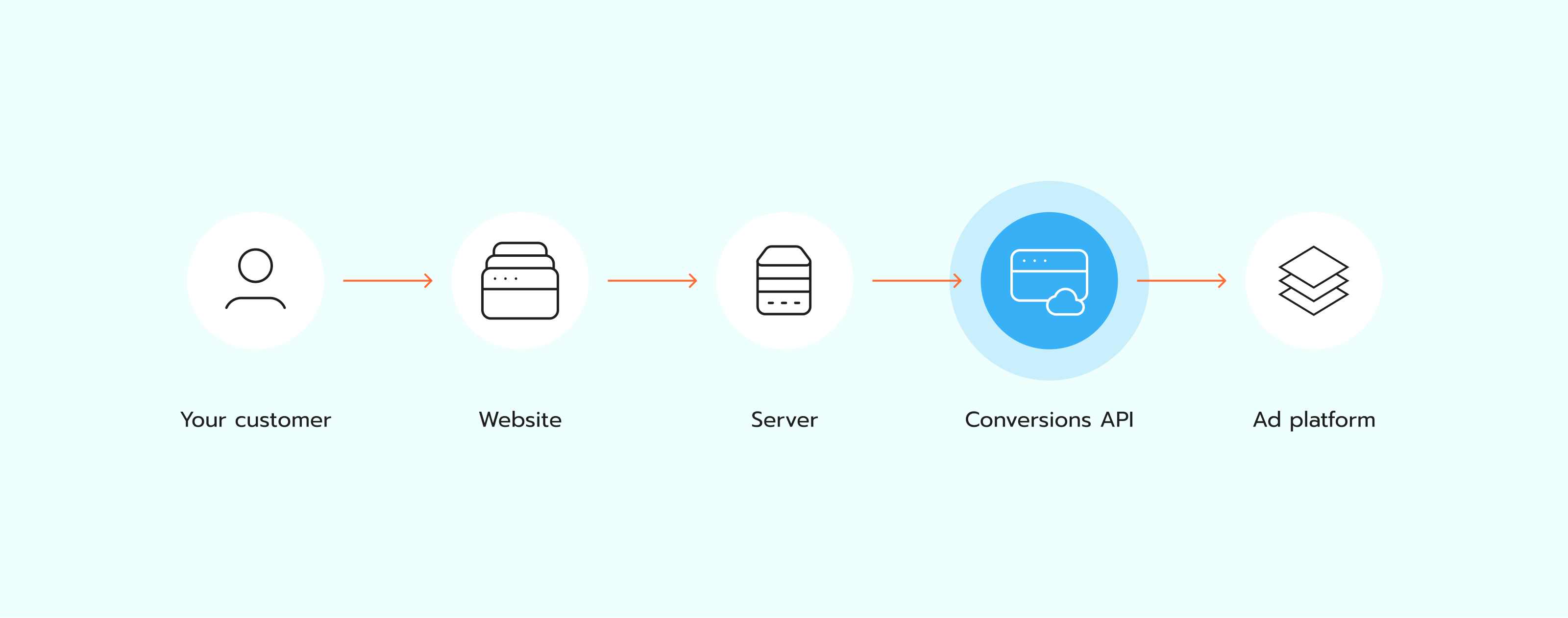
By establishing a reliable, server-to-server link between your website, app, CRM, or offline sales system, Conversions API helps businesses track a wide range of events, including:
- Website events. When users add an item to their cart in an e-commerce store.
- App events. When a user completes a level in a mobile game.
- Offline conversions. When a customer makes an in-store purchase.
- Messaging events. When a user inquires about a product via Facebook Messenger or Instagram Direct.
- CRM events. When a sales rep logs a phone call with a prospect in a CRM.
Here's how businesses are getting smarter with CAPI: it lets you see exactly how your ads are performing and tweak them based on real data, not guesswork. CAPI provides a more reliable way to track real user actions. Think of it as reducing noise in your data – instead of relying on incomplete signals, you get a clearer picture of actual conversions, not just clicks.
Why does this matter? Because throwing money at ads without accurate tracking is like driving blindfolded. We'll walk you through the nuts and bolts of CAPI - from how it works in the real world to getting it up and running in your business. You'll see how companies are using it to cut through the noise and get their ads in front of the people who actually want to see them, all while playing by the privacy rules.
Benefits of using Conversions API
Using Conversions API offers multiple advantages for advertisers and businesses looking to improve the accuracy and efficiency of their digital marketing efforts. Unlike traditional pixel tracking, which relies on browser-based mechanisms, CAPI establishes a direct server-to-server connection, ensuring more reliable data transmission.
Here are the key benefits of implementing the Conversions API:
- Improved data accuracy. Since CAPI sends conversion data directly from a business's server to advertising platforms, it significantly reduces data loss caused by browser restrictions, third-party cookie limitations, and ad blockers. Whether you are utilizing Meta's API or helping Google Ads track conversion events through its server-side equivalent, this means you receive more complete and reliable conversion tracking, allowing them to make better-informed decisions.
- Better performance tracking. Accurately measuring conversions is crucial for optimizing marketing campaigns. With CAPI, advertisers can track actual user actions – such as purchases, sign-ups, or lead form submissions – without relying solely on pixel-based tracking, which can be blocked or distorted by various browser settings. This leads to more precise performance metrics and better budget allocation. For strategies on turning those leads into customers, see our lead acquisition guide.
- Privacy compliance and data security. As global privacy laws like GDPR and CCPA evolve, businesses must prioritize user data protection. CAPI ensures that conversion data is transmitted securely, giving companies more control over what information is shared while aligning with regulatory requirements. By using server-side tracking, businesses can continue to measure marketing effectiveness without compromising user privacy.
- Enhanced ad personalization. CAPI allows advertisers to send verified conversion data, improving audience targeting and retargeting efforts. Since the data is complete and accurate, ad platforms can use it to optimize ad delivery better, increase relevance, and improve return on ad spend (ROAS). It means businesses can reach higher-intent audiences and drive stronger engagement and conversions.
- Resilience against browser limitations. As browsers implement stricter privacy policies, traditional tracking methods face growing challenges. CAPI helps businesses maintain reliable conversion tracking by transmitting data directly from the server, reducing reliance on client-side methods. This ensures more consistent performance despite changes like Apple’s iOS privacy updates and ongoing discussions about third-party cookie alternatives.
Integrating Conversions API helps businesses keep their marketing running smoothly as tracking rules change, reduce data discrepancies, improve data integrity, boost advertising efficiency, and tay compliant with evolving privacy regulations – all while giving them a clearer understanding of their campaign performance and customer behavior.
Popular platforms supporting Conversions API
After years of relying on pixel tracking, marketers are switching to server-side data feeds like CAPI – a game-changer that keeps conversion data flowing even when browsers get picky about cookies. The direct server connections mean you'll finally see the true impact of your ad spend, instead of wondering which sales actually came from your campaigns.
Let’s explore some of the key platforms that support this technology:
| Platform | Conversion API |
| Meta | Meta Conversions API (Facebook CAPI) |
| Google Ads API | |
| LinkedIn Conversions API | |
| Twitter Conversions API | |
| Snapchat | Snapchat Conversions API |
| Pinterest Conversions API | |
| Reddit Conversions API | |
| Amazon | Amazon Conversions API |
By integrating these Conversions APIs, businesses can collect complete and reliable conversion data, refine ad targeting, and stay compliant with evolving data privacy regulations, ultimately.
How to implement Conversions API
Implementing the Conversions API is a multi-step process that requires careful planning and attention to detail to ensure smooth integration. Below are the key steps involved in setting up the Conversions API:
- 1.Choose your integration method. The first step is to decide how you'll integrate the Conversions API into your system. You can go with a direct API integration, which involves writing custom code to communicate with the API. Alternatively, you can use third-party tools like Google Tag Manager (GTM), Conversions API Gateway, or Google Tag Gateway for first-party Google measurement. These offer simplified integration options without requiring much custom development work. Depending on your technical resources and expertise, you'll need to select the best option for your business.
- 2.Set up a server environment. Once you've chosen your integration method, the next step is to ensure your server environment is set up correctly. Your server must be configured to handle and transmit data to the relevant advertising platform securely. It involves ensuring that proper encryption and security measures are in place to protect user data during the transmission process. It's important to verify that your server can securely send conversion data to the platform without risking exposure to unauthorized access.
- 3.Generate an API access token. To authenticate your server's connection to the advertising platform, you'll need to generate an API access token. This token is like a digital key that grants your server permission to communicate with the platform's API. The token is usually generated through the platform's developer console or dashboard, and you will need to follow the specific instructions provided by the platform to ensure the token is created and stored correctly.
- 4.Define event parameters. Once you have access to the API, you will need to define which events you want to track. These events might include purchases, form submissions, leads, sign-ups, or other actions taken by users that you want to measure. Defining these events is a critical step because it determines which types of user interactions will be captured and sent to the platform for analysis. You'll need to clearly outline the event parameters in the API request to ensure accurate tracking.
- 5.Send data to the API endpoint. Once you've mapped out what data you want to track, the next step is packaging it up in a way that the API can understand - think of it like speaking the API's language. You'll need to craft your HTTP requests just right, following the platform's specific recipe for success. Get the format wrong, and you might end up with missing or wonky data in your reports. Each platform (like Meta or Google) has their own playbook for this, so you'll want to keep their docs handy while building out your requests.
- 6.Monitor and optimize. After the data is successfully transmitted, it's important to continuously monitor the conversion data flow to ensure everything works as expected. Regularly reviewing the data is essential for identifying any potential issues, such as incomplete tracking or discrepancies in the reported conversions. Optimization may involve fine-tuning the event parameters, adjusting the server settings, or even integrating additional tracking methods if necessary to improve the accuracy and completeness of the data. Over time, this ongoing monitoring and optimization process helps ensure that the Conversions API continues to provide valuable insights into your campaign performance.
Case studies
Case study 1: enhancing Facebook Ads performance with Conversions API
A public doctoral-graduating (R2) university started to collaborate with the Agency New Path to improve its Facebook ad campaigns. Integrating the Facebook Conversions API helped reduce CPM from $7.80 to $3.81, leading to a 568% increase in leads and a 204.05% rise in completed registration. These results highlight the effectiveness of combining FB Pixel with CAPI, as shown in a detailed comparison of Facebook Ads performance.
Case study 2: boosting e-commerce Conversions through server-side tracking
Farmsave (an Italian online pharmaceutical retailer) started partnering with Tag Manager Italia using Stape's server-side tracking solutions to reduce data discrepancies. The percentage of inaccuracy was decreased from 20% to 6%. By improving the accuracy of data collection, the cross-selling strategy was able to be more effective, leading to an 88% increase in conversion for Facebook ad campaigns.
CAPI server-side tracking: real Stape users' problems solved
One Stape user reported spikes in purchase events when using CAPI server-side tracking with WooCommerce, which made Meta campaign results look overstated. In the full thread, the issue was traced to a misconfigured deduplication setup that caused extra server-side events to be counted. After correcting the deduplication settings, the over-tracking stopped and purchase numbers returned to normal.
FAQs
Conclusion
The shift to Conversions API represents a critical turning point in digital advertising. While traditional pixel tracking served us well in the past, today's privacy-focused landscape demands more robust solutions. The data shows that businesses embracing server-side tracking through CAPI are gaining a significant edge in campaign optimization and customer insights. For online retailers, software companies, and digital marketers, this technology has moved beyond being merely advantageous – it's now fundamental to maintaining market position.
By investing in CAPI infrastructure today, companies aren't just solving current tracking challenges; they're building a foundation for sustainable marketing success in an increasingly privacy-conscious digital world. The evidence is clear: those who adapt to this new paradigm will be best positioned to thrive in tomorrow's marketing landscape.
Want to start on the server side?
Try for freeRecommended for you
Aug 3, 2026
Blog
Targeted advertising: what is and how to improve?
This guide explains effective strategies for identifying the right audience, optimizing your ads, and achieving better results.
May 8, 2026

Comments