Sep 28, 2026
Marketing attribution models: which one to choose in 2026
Written by
Liudmyla Kharchenko
Updated Aug 3, 2026 comments
You picked an attribution model, set up tracking, and started collecting data. Now comes the part that actually shapes budget decisions: understanding what the numbers mean and which model is telling you the truth.
Attribution isn't a one-time setup. Customer journeys span more channels than ever, privacy rules keep changing what you can measure, and the model you picked six months ago may no longer reflect how your customers actually convert. Getting this right means knowing what each model shows you, where it falls short, and when it's worth switching.
This guide walks you through the main digital marketing attribution models, how to choose between them, and how to put your setup to work in 2026.
What is a marketing attribution model?
Marketing attribution relies on marketing attribution models to assign value to customer interactions. Simply put, an attribution model is a set of rules that determines how credit for a conversion is distributed across the various touchpoints or channels involved in the customer journey.
Here’s a more full marketing attribution model definition:
| Marketing attribution model is a method to decide which interactions in a customer’s journey deserve credit for a sale or conversion. It helps businesses understand which touchpoints - such as ads, website visits, or social media clicks - contribute the most. For instance, the Last Interaction model gives full credit to the last touchpoint before the conversion, assuming it was the deciding factor in the purchase. |
A marketing channel attribution model is vital for understanding which customer interactions led to sales and how they did it. So, when choosing an attribution model for your business, one thing is sure - it’s essential to choose wisely. Identifying the best marketing attribution model can lead to better decision-making and more effective marketing strategies. And the choice is vast.
Let’s go through the types of digital attribution models to understand how they work and when/where to use them to drive the best marketing results.
Types of marketing attribution models
In GA4 Attribution reports, there are 3 available attribution models: data-driven attribution, paid and organic last click, and Google paid channels last click.
Used till 2023, first click, linear, time decay, and position-based models are now deprecated in Google tools. Google replaced them with data-driven attribution for conversion actions that still used them.
Look at the infographic below to discover the attribution models, how they distribute credit, and where they're best used.
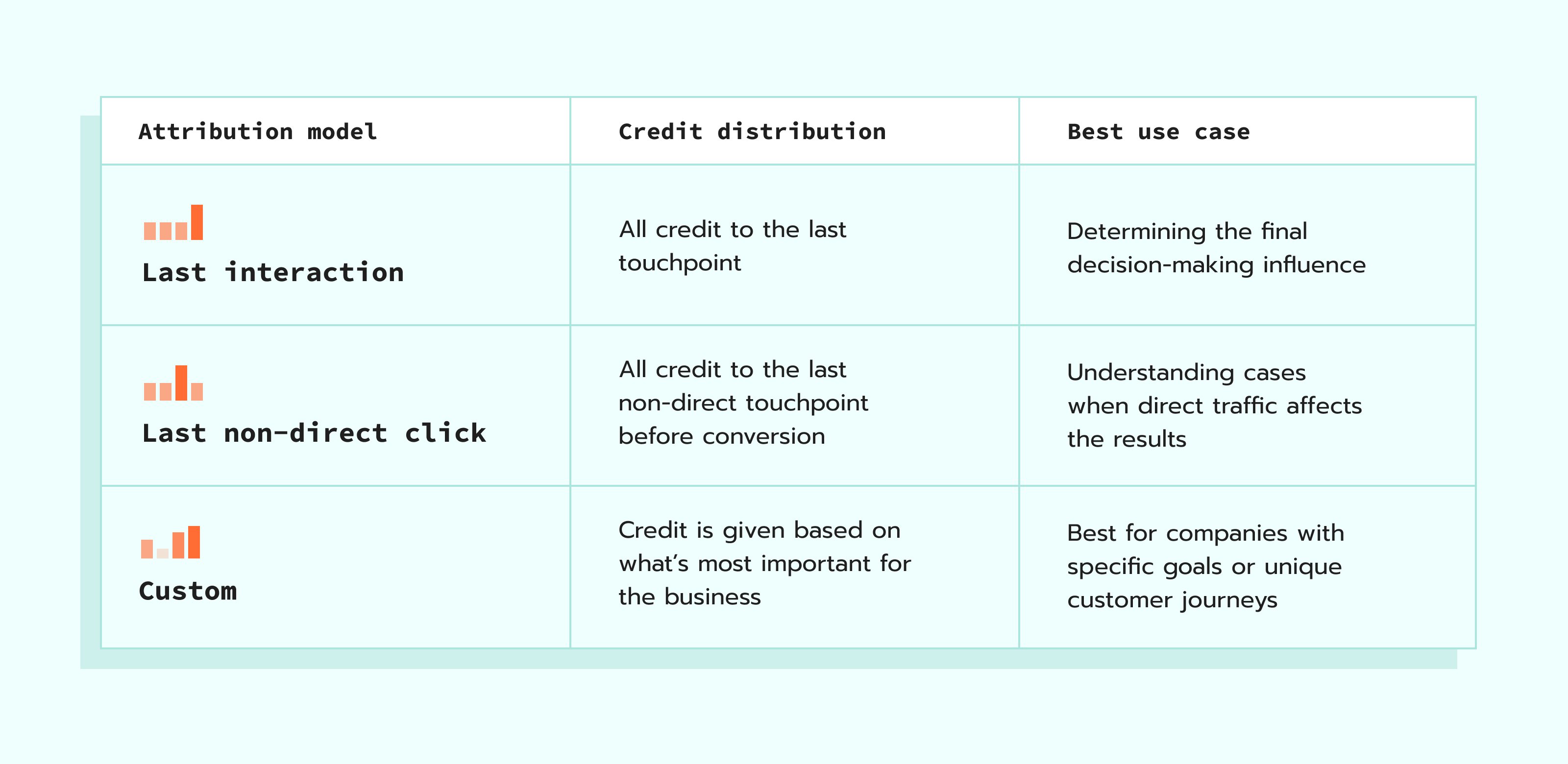
Now, let's dive into each of the attribution models.
| Note: setting up event tracking in GA4 correctly is crucial for any marketing attribution model. |
Last interaction attribution
Instead of giving credit to the first point of contact, the last interaction attribution model assigns all the credit to the final touchpoint before the user converts. This model assumes that the last interaction is the most critical factor in driving the user to take action.
Marketers often use last-click attribution to identify which channels directly lead to conversions. While this model helps measure the effectiveness of closing strategies, it doesn’t account for earlier interactions that may have played a role in influencing the user’s decision.
Here’s how last-click attribution works in practice for marketing campaign attribution:
Imagine a user planning a vacation and seeing a banner ad for a hotel booking website while reading a travel blog. They click on it, browse briefly, but don’t book. A week later, they see an Instagram ad from the same company, click on it, and finally book their trip. In the last-click attribution model, all the credit goes to the Instagram ad, as it was the final touchpoint that directly led to the booking.
Last non-direct click
This digital marketing attribution approach assigns all credit for a conversion to the last touchpoint that wasn’t a direct visit. Direct visits (such as when a user types the URL directly into the browser) are excluded from the credit, even if they happen last in the conversion path.
This model identifies the last interaction that contributed to the conversion while ignoring any direct traffic that might have occurred right before it. This model works well when marketers want to focus on the last significant marketing interaction that led to conversion while filtering out the influence of direct traffic.
For example, if a user first comes across a travel booking site through a banner ad, later visits the website directly, and then makes a booking after clicking on a Google search ad, the last non-direct click attribution model would give all the credit to the Google search ad, ignoring the direct visit before the conversion.
Custom attribution model
A custom attribution model is a flexible approach where marketers set up rules for how the credit is given to different touchpoints in a customer’s journey. Unlike standard models like first-click or last-click, it can be adjusted to fit the unique needs of a business.
Marketers use this model when they want to match attribution to their specific goals or the key interactions that lead to conversions.
For example, a travel company might give less credit to a banner ad that raises awareness while giving more credit to an Instagram ad if it leads directly to a booking. This approach helps businesses track their marketing efforts in a way that aligns with their goals.
What is cross-channel attribution?
Each of the marketing attribution models we’ve just discussed focuses on different stages or touchpoints in the customer journey. And, often, they do it within a single channel. The modern marketing environment is quite dynamic, and a customer can interact with a brand through multiple touchpoints during one customer journey, both online and offline.
Here’s why we need to talk about multi-channel attribution modeling. This broader approach helps marketers evaluate how different marketing channels work together as the customer journey progresses. In GA4, cross-channel attribution uses the currently supported models: data-driven attribution, paid and organic last click, and Google paid channels last click. Still, it applies them to various platforms, offering marketers a clearer understanding of how each interaction contributes to the final conversion.
How to choose between marketing attribution models?
Understanding cross-channel attribution gives marketers a clearer picture of how different touchpoints work together, but the question remains: how to choose an attribution model that fits your business?
With so many marketing attribution models available, choosing the right approach depends on your goals, customer journey, and the advertising attribution strategy you want to implement. Let’s break down how to decide which model will give you the most accurate insights and drive better marketing decisions.
Unfortunately, or luckily, there’s no one-size-fits-all attribution model. The best choice depends on many factors that a marketer needs to consider:
- Marketing goals. This is the main factor behind the choice of an attribution model. The choice will differ based on your focus goal: brand awareness, engagement, conversions, etc.
- Length of the sales cycle. Prioritizing early or late touchpoints often depends on the length of the sales cycle.
- The complexity of the customer journey. The more touchpoints the customer journey has, the more effective an attribution model that distributes credit is required.
- Number of marketing channels. A broad attribution approach is needed if many channels are involved in the customer journey.
- Budget. Choosing a model that reflects the impact of each touchpoint facilitates marketing budget optimization and helps a business focus on channels and efforts that perform best.
- Data availability. Advanced attribution models need reliable data and strong analytics tools to be effective. Before choosing a model, consider whether you have the data and the tracking capabilities.
Selecting the right attribution model requires carefully evaluating your business goals, customer journey, resources, and data. This lets you see which approach aligns with your marketing strategy and helps you optimize your marketing performance.
How to implement an attribution model
You must take several steps to implement an attribution model for your marketing campaign.
1. Define your business goals. You need to clarify your objectives before you pick an attribution model. What are the KPIs you are looking for? Is it brand awareness, conversions, customer lifetime value, or something else?
2. Collect and organize your data. Clean and structured data will help you get the most out of your chosen attribution modeling marketing setup. Gather and structure data you get from a website or app analytics, ad platforms, CRM, marketing automation tools, and custom tracking (like server-side tracking). You can use the ROAS calculator to estimate your potential CPA with server-side tracking.
3. Pick an attribution model. It’s time to select an attribution model that fits your needs.
4. Set tracking and data integration:
- Set up UTM parameters (add unique tags to your URLs to track where your website traffic is coming from) to track campaign source details.
- Integrate tracking pixels.
- Set up event-based tracking.
- Connect CRM, ad accounts, and analytics platforms to bring all your data into one place. This integration helps unify information from: CRM apps, advertising accounts, and analytics tools.
5. Analyze your data and determine how much credit each marketing channel deserves:
- Experiment with different attribution models to see how they impact results.
- Use reporting tools (like Looker Studio) to get a deeper insight into the data.
6. Optimize your attribution model(s) based on insights you get:
- After discovering what marketing channels work best, adjust your budget accordingly.
- If it makes sense, try different attribution models to see if they would drive better results.
- Study how customers interact with different campaigns to improve your campaigns.
7. Automate and scale:
- Automate data collection using APIs to pull data from various sources, such as CRMs, Google Analytics, and ad platforms (for example, Facebook, TikTok, or Google Ads).
- Continuously test and refine your attribution model.
Why should I care about marketing attribution in 2026?
You need marketing attribution models to determine which parts of your marketing efforts bring in customers.
Marketing attribution is more important than ever in 2026, as customer acquisition costs are rising. Ads are getting more and more expensive due to the increased competition. In the saturated digitalized environment, you are no longer unique with any service or product. Knowing how to track your ads precisely can help you allocate the budget smarter.
Privacy rules change, data regulations get stricter, and traditional tracking experiences many hardships because of these factors. A strong attribution model can help you make data-driven decisions.
Moreover, without attribution, you won’t see the complete picture of your customers’ interaction with your brand. The road is long and curvy: social media, display ads, email, search ads, influencer marketing, and more. Customers move through various touchpoints before converting, and a strong attribution model helps you identify which ones make a difference.
In 2026, marketing attribution is essential for smart spending. With rising customer acquisition costs and stricter privacy regulations, relying on external tools alone isn’t enough. A solid attribution model lets you make data-driven decisions, improve your ROI, and ensure your marketing budget goes further. Understanding the customer journey allows you to optimize your efforts and stay competitive in a crowded marketplace.
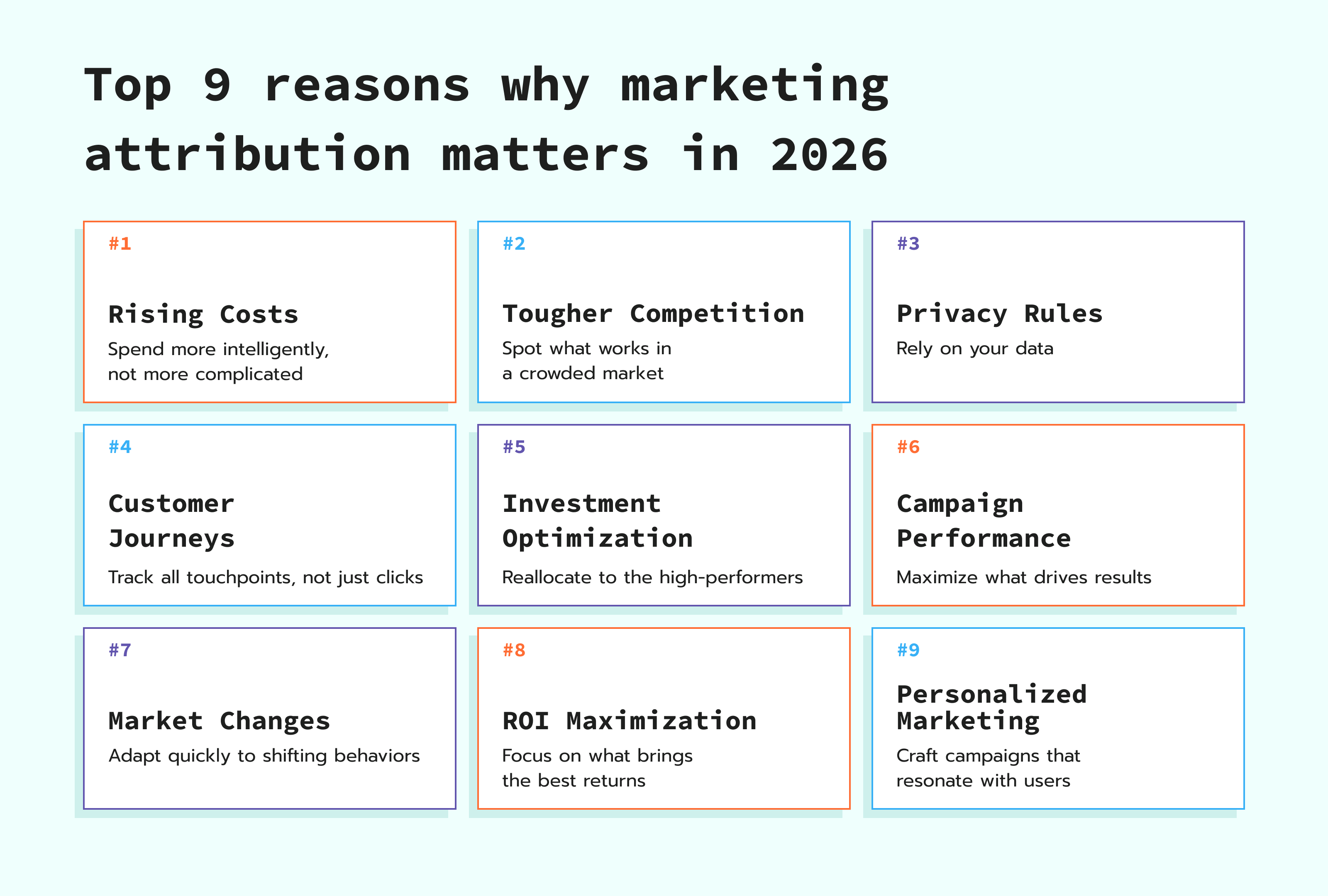
Top 10 reasons why marketing attribution matters in 2026
Want to make smarter marketing decisions? Attribution helps you see what’s working, optimize your budget, and drive better results. Here are the top 10 reasons it’s a must in 2026:
- 1.Rising costs. Ad spend keeps climbing. Attribution helps you spend not just more, but more precisely. When you know what performs, every dollar works harder.
- 2.Tougher competition. Most markets are crowded. Attribution shows you what's working and what's just adding noise. That clarity helps you focus on what actually moves the needle.
- 3.Privacy rules. Third-party cookies are going away. GDPR, CCPA, and similar regulations limit external tracking. A first-party attribution strategy lets you rely on data you own.
- 4.Customer journeys. Customers rarely convert on the first touchpoint. They scroll, read, compare, and click across multiple channels before making a purchase. Attribution helps to track the full path, not just the last step.
- 5.Investment optimization. Attribution tells you which channels drive revenue and which ones only look good in reports. You can shift the budget toward high performers and pull back from those that aren't delivering.
- 6.Campaign performance. Marketing campaign attribution lets you measure individual campaign impact more accurately, so you can act on what drives results rather than guessing.
- 7.Market changes. Consumer behavior shifts quickly. Attribution gives you data to respond to those changes in near real-time, rather than waiting for end-of-quarter reports.
- 8.ROI maximization. Advanced attribution models help you focus on what brings the best return. Better attribution tends to mean better ROI over time.
- 9.Personalized marketing. Understanding which touchpoints resonate with which audience segments lets you build campaigns that feel relevant. Attribution provides the data layer that makes personalization at scale possible.
- 10.Competitive advantage. Businesses that invest in marketing attribution modeling make better decisions faster. In tight-margin markets, that advantage compounds over time.
Choosing among marketing attribution models is ultimately a budget decision: the right one shows which channels earn their spend.
FAQs
Want to start on the server side?
Try for freeRecommended for you
Aug 18, 2026
Blog
How to set up Salesforce tag using server GTM
Find out how you can set up lead events tracking using the Salesforce tag for server GTM developed by Stape.
Jul 22, 2025

Comments