Server-side tracking myths busted: what you actually need to know
Written by
Tymofii Sankov
Key takeaways:
- Server-side tracking is accessible and beneficial to businesses of all sizes and budgets. Stape allows you to try it for free and scale your setup whenever your needs grow.
- Implementation is easy. Managed infrastructure, Setup Wizard, Tracking Checker, and other Stape tools reduce the amount of manual work needed.
- Server-side tracking provides more accurate and reliable data. It helps reduce data loss caused by ad blockers, cookie limitations, browser restrictions, and other factors.
- It does not require constant manual maintenance. Once configured, it does not need regular manual intervention. Stape further reduces the maintenance burden by managing the infrastructure, providing 24/7 SRE monitoring, and offering a vast toolkit that simplifies ongoing tracking management.
It is not the first year server-side tracking has been with us. It has already been quite some time, and yet many businesses still hesitate to implement it, despite its undoubted benefits. The main obstacles often mentioned as reasons are that server-side tracking is expensive, hard to configure, requires constant maintenance, is not as effective as it is viewed, etc. Of course, no smoke exists without fire, and most of these "accusations" WERE valid. Time passes, the technology improves, and what used to require significant resources for questionable functionality can now be much more effective and affordable.
In this article, we will take a closer look at four common server-side tracking myths, explain where they come from, and see how well they hold up in practice.
Server-side tracking is more affordable than many people think

Let's start with one of the most common concerns about server-side tracking: cost. Server-side tracking uses server infrastructure to process incoming requests, so a new hosting element is added compared to the traditional client-side tracking setup. If you use a cloud provider like Google Cloud Platform for hosting, the final cost heavily depends on the infrastructure complexity and required resources.
This is where Stape makes a significant difference. We take an alternative approach, combining the required infrastructure with a vast toolkit developed specifically for server-side tracking. You can start with a free plan and move through the available tiers as your business expands, traffic grows, and requirements become more complex.
To make things even more transparent, we have a convenient pricing calculator that would allow you to plan your spending and predict costs associated with your server-side tracking config. You enter the number of expected monthly events, what other tools you want to use, and see how much it will cost your business.
If you already invest significantly in paid advertising, even a tiny improvement can outweigh the monthly cost of server-side tracking. The ability to start with Stape at $0 and scale up together with your business according to your needs also helps to keep your spending proportional to your requirements.
After implementing server-side tracking with Stape, SportSpar reduced its cost per purchase by 24% and increased ROAS by 32%, providing a clear example of how improved tracking can translate into measurable advertising performance.
Server-side tracking can be implemented quickly and almost effortlessly

The word "server" makes the overall term "server-side tracking" sound more technical than it actually is. In fact, the amount of technical work to do heavily depends on the implementation method you choose.
If you decide to use Stape, for instance, we will manage all the infrastructure and hosting without requiring any involvement from your side. This way, you can focus solely on the server container, configuring the tags and destinations you need. If you have already worked with Google Tag Manager when setting up client-side tracking, many things will already be familiar to you.
Apart from taking care of the infrastructure and hosting, Stape also has numerous integrations and tools aimed at simplifying different aspects of implementation.
- Setup Wizard. Instead of manually creating tags, triggers, clients, and variables for every platform, you answer a short questionnaire, select your CMS and tracking destinations, and provide the necessary IDs and tokens. Setup Wizard then generates personalized web and server GTM container templates and can import them into GTM automatically.
- Free CMS and CRM integrations. Stape offers apps, plugins, and extensions for popular platforms, including Shopify, WordPress, Magento 2, BigCommerce, Wix, PrestaShop, and Salla. They automate parts of the setup that would otherwise require manual configuration, such as enriching the data layer, sending eCommerce events, or connecting sales data with advertising platforms.
- AI Assistant. Stape's AI Assistant can interact with the Stape ecosystem and connect Google services using natural-language prompts. Among other supported tasks, it can analyze GA4 data and GTM containers and create, modify, or delete variables and templates in Google Tag Manager.
- Website Tracking Checker. Analyze your website's current tracking setup and identify potential weak points that may contribute to lost conversion data or inaccurate measurement. The tool does not modify your setup automatically; instead, it highlights areas that deserve attention and may benefit from improvement.
The exact implementation ultimately depends on the website and tracking requirements. A standard implementation can be covered almost solely by Stape, while a heavily customized setup may require slightly more involvement from your side. Either way, you do not have to build the server infrastructure from scratch yourself.
Server-side tracking is much more effective than a pure browser-based setup
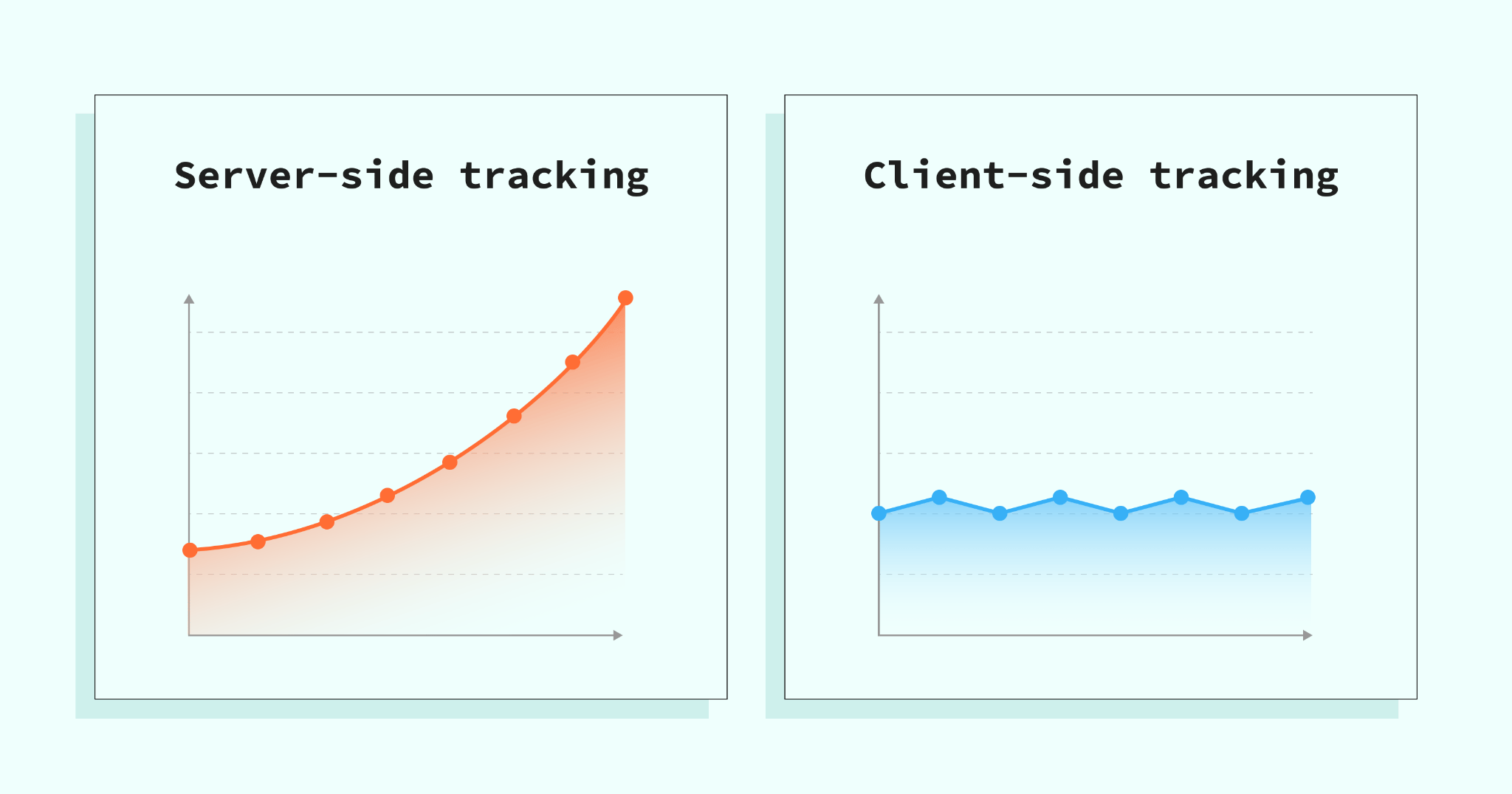
The larger your advertising budget, the more you may be losing by relying solely on client-side tracking. In some cases, those losses can easily outweigh the cost of implementing server-side tracking. But why is that?
Сlient-side tracking can miss conversions due to ad blockers, browser restrictions, cookie limitations, and other factors. When some conversions and user interactions never reach your analytics and advertising platforms, campaign decisions are made using an incomplete picture of customer behavior. Over time, this can affect attribution, optimization, and ultimately the efficiency with which your advertising budget is spent.
Server-side tracking helps mitigate many of these issues by introducing an additional processing layer between your website and the platforms receiving your data. This gives you greater control over the information being collected, allowing you to enrich, validate, and refine events before they are sent to analytics and advertising platforms, which can improve conversion tracking. For instance, Google reports that Square saw almost a 50% increase in conversion measurement with the implementation of server-side tracking.
As a result, campaign optimization is based on more complete and reliable data. Moreover, once your server container is running, you can extend its functionality with Stape's power-ups and built-in features designed specifically for server-side tracking. Depending on the feature and plan, these can help reduce data loss, improve data quality, extend cookie lifetime, enrich or transform incoming data, filter unwanted traffic, and automate particular tracking processes. For many businesses, all these improvements can translate into measurable changes in overall marketing performance, including CPA reductions of up to 20%.
What's more, you don't have to rely on assumptions to evaluate the impact. Stape Analytics measures the uplift after server-side tracking is implemented, allowing you to compare your tracking before and after the migration and see how it affects your data quality.
A good example comes from ZweiDigital, an agency specializing in performance marketing. After the agency migrated SportSpar’s tracking to Stape’s server-side configuration, a 24% reduction in CPP and a 32% ROAS improvement were observed. Moreover, this switch boosted EMQ, enhanced conversion deduplication, and reduced the load on the website’s hosting server.
So, the real question is not whether client-side tracking works, but whether it provides you with enough accurate data to make informed and cognitive business decisions. As advertising platforms increasingly rely on machine learning to optimize campaign performance, providing them with the most complete and reliable data possible becomes even more important.
Server-side tracking does not require constant maintenance

It might seem that adding a server to your tracking setup requires additional attention and maintenance. In practice, however, things are much simpler. Once you finish the initial setup of the tags, data flows, and destinations, your server-side tracking setup can operate without constant manual maintenance.
Obviously, whenever you update your website, add new events, or analytics platforms change their requirements, you may need to adjust your tracking setup accordingly. However, these operations are not specific to server-side tracking; they are common maintenance tasks that apply to any tracking setup, including client-side tracking.
Stape makes ongoing server-side tracking maintenance even easier.
| Area | What ongoing maintenance looks like |
|---|---|
| Server infrastructure | Managed by Stape |
| Infrastructure health and availability | Monitored 24/7 by the Stape SRE team |
| Tracking health | Monitoring feature informs you when potential issues are detected |
This means that server infrastructure maintenance when switching to server-side tracking is taken off your hands. With Stape handling the server infrastructure, providing you with the tools to simplify configuration, and alerting you when potential issues are detected, you can focus on your marketing strategy and data analytics rather than worrying about the technical aspects.
Conclusion
Server-side tracking is much more accessible for companies of different sizes, budgets, and technical backgrounds. It provides marketers with greater control over the tracked data that is sent to advertising platforms and analytics. This creates a much stronger foundation for accurate measurement and informed decision-making.
Stape is a great example of how server-side tracking can be implemented with minimal effort, combining managed server infrastructure with an extensive toolkit aimed at simplifying configuration, tag management, monitoring, and ongoing maintenance. At the same time, flexible plans allow you to start for free and scale your setup whenever your actual needs grow.
It is important to understand that server-side tracking is not a technology reserved for large businesses only. With the right configuration and tools, you can benefit from more reliable tracking no matter how big your company is or how much revenue it generates.
Want to start on the server side?
Try for freeRecommended for you
Jul 2, 2026
Blog
Requests Analytics: measure the impact of your server-side tracking
Analyze server-side tracking with Requests Analytics. Measure data recovery, ad block impact, and browser restrictions. Prove ROI and boost data accuracy.
Oct 1, 2026

Comments