Nov 9, 2026
+29.2% net profit from Google Ads with POAS Data Feed | Data Revolt
Written by
Marian Becheanu
Published Nov 20, 2026 comments
Key takeaways
- Kfea's Google Ads Performance Max campaign was bidding on purchase revenue, so Smart Bidding couldn't distinguish a high-margin product from a low-margin one with the same price.
- Data Revolt added Stape's POAS Data Feed to Kfea's existing server container on Stape. The feed started matching each purchased item to its margin, allowing server-side profit calculation.
- From then on, margins stayed in Stape and never reached the browser or the dataLayer. Only the calculated profit was sent server-to-server to Google Ads and GA4.
- During a one-month benchmark, the campaign continued bidding on revenue while profit was recorded in GA4. After the benchmark, the campaign's conversion value switched from revenue to profit.
- After one month of profit-based bidding, Kfea saw +29.2% net profit, measured against the PMax spend, and +33% more budget going to products with above-median margin.
Kfea.ro is a Romanian online coffee retailer that sells coffee beans, ground coffee, and capsules sourced directly from producers. Its catalog includes products with widely varying margins, often at similar price points.
The Google Ads account, driven mainly by a Performance Max (PMax) campaign, was already delivering a strong return on ad spend (ROAS). The goal was to make the same budget earn more profit, not just more revenue.
The project was led by Data Revolt, a Stape partner agency based in Bucharest. Data Revolt had already moved Kfea's tracking to server-side GTM hosted on Stape, so the foundation for profit-based bidding was in place.
Challenge: Smart Bidding was optimizing for revenue, not for profit
The existing tracking setup wasn't experiencing significant data loss. Server-side GTM on Stape already protected conversions from ad blockers and browser restrictions. The issue was the conversion value being sent to Google Ads.
- Revenue was the only signal: every purchase reached Google Ads with its order value. Two orders with the same purchase value looked identical to Smart Bidding, even when one generated far more profit than the other.
- Margins varied widely across the catalog: a more expensive product with a thin margin could earn less per sale than a cheaper product with a healthy margin. Revenue-based bidding could favor higher-priced products, even when their margins were lower.
- Strong ROAS didn't necessarily mean strong profitability: without product margin data, Smart Bidding couldn't distinguish products generating more revenue from those generating more profit.
- Margin data had to remain private: sending product costs or margins through the browser or the dataLayer would expose them to anyone inspecting the site.
Solution: POAS Data Feed on the existing Stape server container
Kfea needed profit as the bidding signal while keeping product margins off the website. Because the server container was already running on Stape, the solution was an upgrade to the existing setup rather than a new project.
The solution combined the following:
- POAS Data Feed: stores product margin data in Stape's secure storage. When a purchase reaches the server container, it matches each item ID to its margin and calculates the profit for the order.
- Server-to-server delivery: profit is calculated on the server and sent from there to Google Ads and GA4. Margin data never appears in the browser, page source, or the dataLayer.
- Server GTM hosting on Stape: the container already sent purchase events to Google Ads and GA4. Adding profit meant changing the value being sent, not rebuilding the tracking setup.
- One feed to maintain: the client supplies one product feed with margins. Stape's auto-sync can refresh it daily or weekly as prices and costs change.
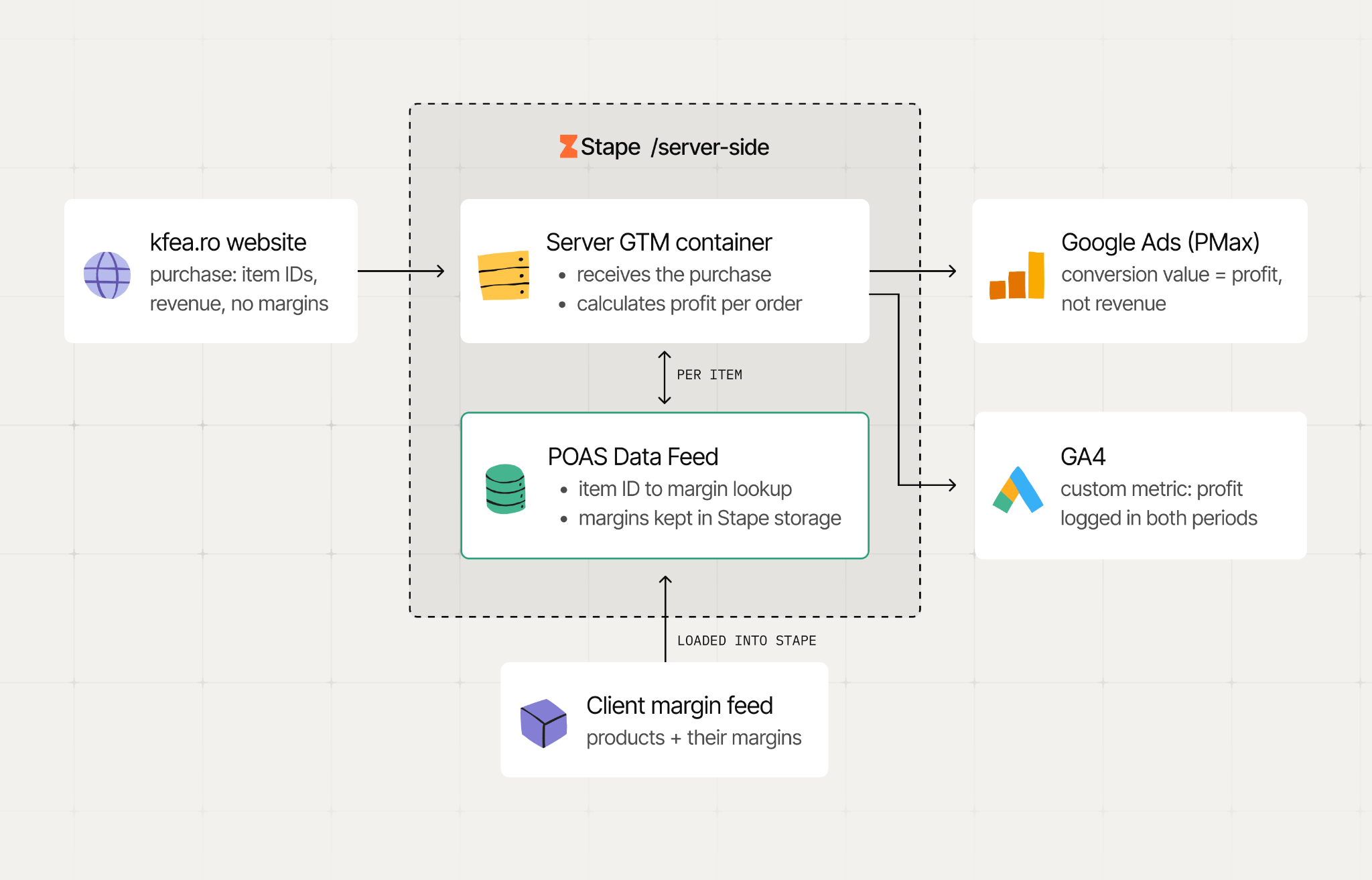
The website only sends item IDs and revenue. Stape adds the margin on the server, and Google Ads and GA4 receive the calculated profit.
Implementation: earning the client’s trust and establishing a benchmark
The technical setup was the smaller part of the work. Most of the effort went into building the client's confidence and designing a measurement approach that could demonstrate the impact.
- 1.Proposing POAS to the client: Data Revolt recommended moving from ROAS to POAS on top of the existing server-side setup, using Stape's POAS Data Feed power-up.
- 2.Addressing margin privacy: the client’s first question was who could see the margins. Data Revolt explained that margins stay in Stape’s secure storage and are used only by the server container to calculate profit. They are never sent to the website or exposed in the browser or dataLayer.
- 3.Loading the margin feed: the client provided a feed of the products they wanted to promote, each with its margin. Data Revolt uploaded it to POAS Data Feed and matched the product IDs to the item IDs in purchase events.
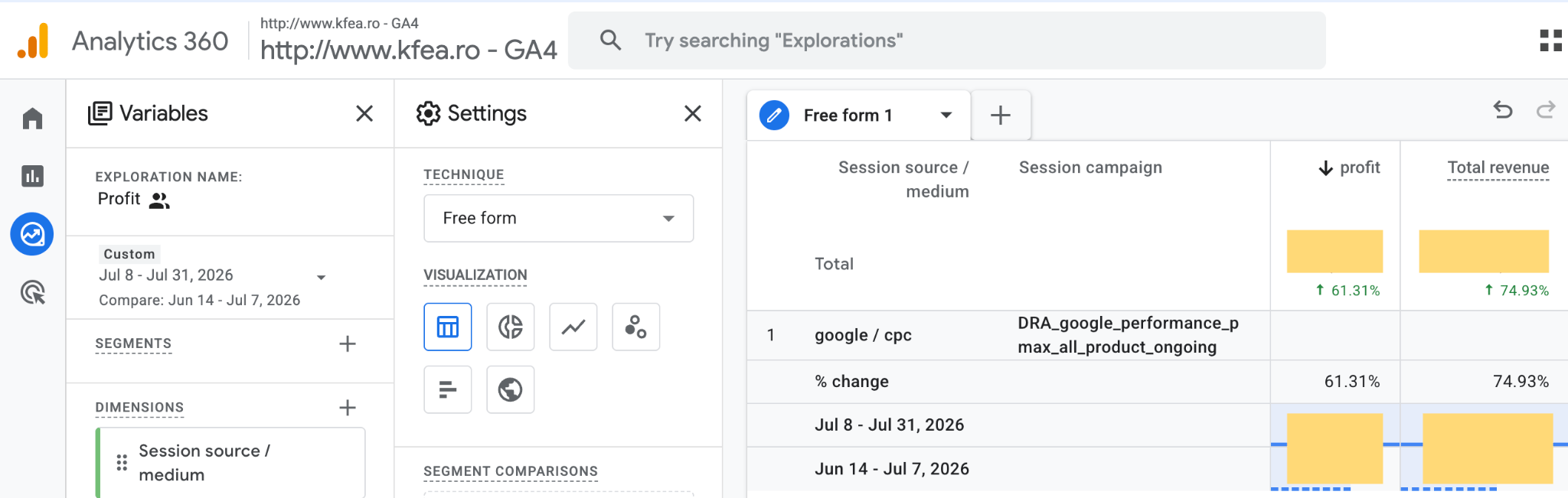
- 4.Benchmarking with the original bidding signal: for one month, the PMax campaign continued bidding on purchase revenue. In parallel, the server container calculated profit for every order and sent it to GA4 as a custom metric named
profit. This established a baseline of profit generated through revenue-based bidding. - 5.Switching the bidding signal: after one month, the server container started sending profit to Google Ads as the campaign's conversion value instead of revenue.
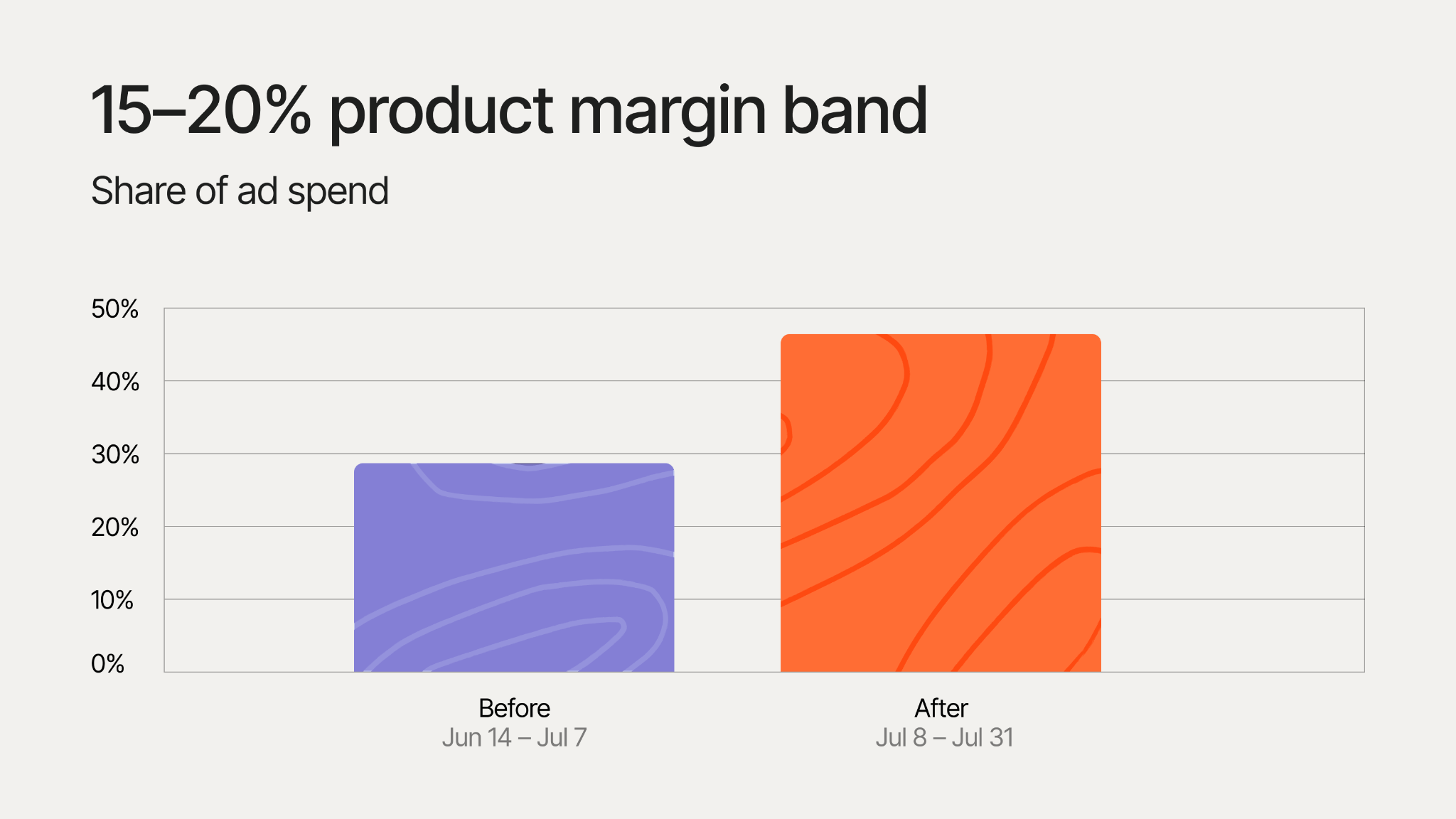
- 6.Measuring the impact: after one month of profit-based bidding, Data Revolt compared the profit generated with the actual PMax budget spent. Separately, the team isolated the products included in the feed and used a Python script to track how budget allocation shifted between higher- and lower-margin products before and after the switch.
Because GA4 recorded profit in the same way during both periods, the before-and-after figures are directly comparable.
Results: more profit from the same campaign
- 29.2% net profit: profit generated after the switch was compared with the actual PMax budget spent. The campaign spent more once it started bidding on profit, and that additional spend was accounted for in the result.
- +33% budget shift toward high-margin products: products with a margin above the catalog median received 33% more of the budget. This showed that Smart Bidding changed its behavior, rather than the profit gain coming only from external factors.
- Margins stayed private: profit was calculated on the server for every order. The website, the browser, and the dataLayer never carried margin data.
- Reporting focused on profit: GA4 now shows profit alongside revenue for every order, so campaign reviews start with the number the business actually cares about.
After the first campaign, the next step is to extend profit-based bidding to Kfea’s other Google Ads campaigns and keep the margin feed in sync as the catalog changes.
Partnering with Data Revolt has helped us view our Google Ads campaigns from a perspective much closer to our business reality, rather than just through the lens of revenue or ROAS. Implementing POAS allowed us to factor in actual product margins and direct our budget toward what is genuinely profitable for us. We saw tangible results right from the very first stage, marking an important step forward for us - from optimizing for volume to optimizing for profitability.
Madalin Chiriac
Head of Marketing and Growth, Kfea.ro
Why profit-based bidding matters for agencies
Most eCommerce accounts still optimize on revenue, and many already have server-side tracking in place. For an agency, that makes POAS the natural next step after a server-side migration: the infrastructure is there, and the conversation with the client moves from data quality to profit.
It also changes the relationship. Reporting in profit puts the agency and the client on the same scorecard, and a measured profit gain is easier to defend than a ROAS figure.
Three recommendations for agencies planning a POAS rollout:
- 1.Build the benchmark before you switch: log profit in analytics while bidding stays on revenue. Without that baseline, you cannot show what the algorithm changed.
- 2.Treat margins as confidential data: keep them out of the browser and the dataLayer. A server-side lookup helps reassure clients that their margin data won't be exposed on the website.
- 3.Prove the shift, not only the total: a profit increase can have many causes. Showing that budget moved toward higher-margin products connects the result to the new bidding signal.
Why choose Stape
For an eCommerce business already running server-side tracking, Stape let Data Revolt move Kfea from revenue to profit-based bidding with configuration rather than new engineering.
Stape gave us the server container and the margin lookup in one place. We added profit-based bidding to a setup the client already trusted, without new infrastructure and without exposing a single margin.
Marian Becheanu
Head of Data, Data Revolt
With Stape, businesses can:
- Send profit instead of revenue to Google Ads, GA4, and other ad platforms, so bidding follows what the business actually earns.
- Keep margins confidential in Stape's secure storage, calculated server-side and never exposed in the browser or the dataLayer.
- Build on the existing container: POAS Data Feed is a power-up for Stape's server-side GTM hosting, so there's no separate system to deploy or maintain.
- Keep margin data current with a single product feed and auto-sync, instead of manual updates inside the tracking setup.
Want to start on the server side?
Try for freeRecommended for you
Blog
ROAS vs POAS: which metric to use?
ROAS measures ad revenue, while POAS measures profit. Compare both formulas and see how Stape helps you send revenue and profit data to ad platforms.
Sep 25, 2026

Comments