Meta on-device conversion measurement: what you need to know
Meta is rolling out Measure conversions on customer devices. It’s a feature that helps advertisers attribute more conversions to their campaigns. Here’s what's changing after the release, what it means, and how it may impact the data.
Why Meta rolls out measuring conversions on customer devices
Meta is trying to solve one of the challenges in digital advertising: connecting ad interactions with conversions that happen later.
For example, the user sees an ad on Instagram, returns to a website several days later, and only then makes a purchase. Even if Meta receives the purchase event, its algorithms may not always be able to connect it to the ad click that happened on day 1.
In this way, advertisers get the gap between the conversions businesses generate and the conversions Meta can attribute to the campaigns. With on-device conversion measurement, Meta aims to improve conversion attribution for such flows.
How the feature might work
Meta has not publicly explained the exact technical mechanism in detail to say for sure how the feature is going to work. The mechanism explained below is more of our guess based on available info from Meta.
The basic idea is that the device has access to two pieces of information:
- Ad interaction – data associated with the Meta ad view or interaction.
- Conversion – information available when the customer later completes a purchase or another conversion on the website.
According to Meta's description, the matching process will use information the customer has previously shared with the business, such as an email address, together with temporary, non-identifying device information. Meta says the identifying information used for the match isn't sent to Meta as part of that process.
However, the exact matching algorithm, identifier-selection logic, and interaction with other tracking mechanisms isn’t documented publicly yet.
It might use available user identification information in a certain priority, for example, as Stape’s Enricher power-up does. It looks for previously collected identifiers in a database, starting with email by default. If email isn’t available, it takes another identifier according to the set priority. This is an analogy, not confirmation that Meta uses the same implementation.
What’s changing with the release
The new feature provides an extra mechanism for matching conversions with advertising interactions – instead of relying on Meta's servers to attribute conversions, the matching will take place on the user's device.
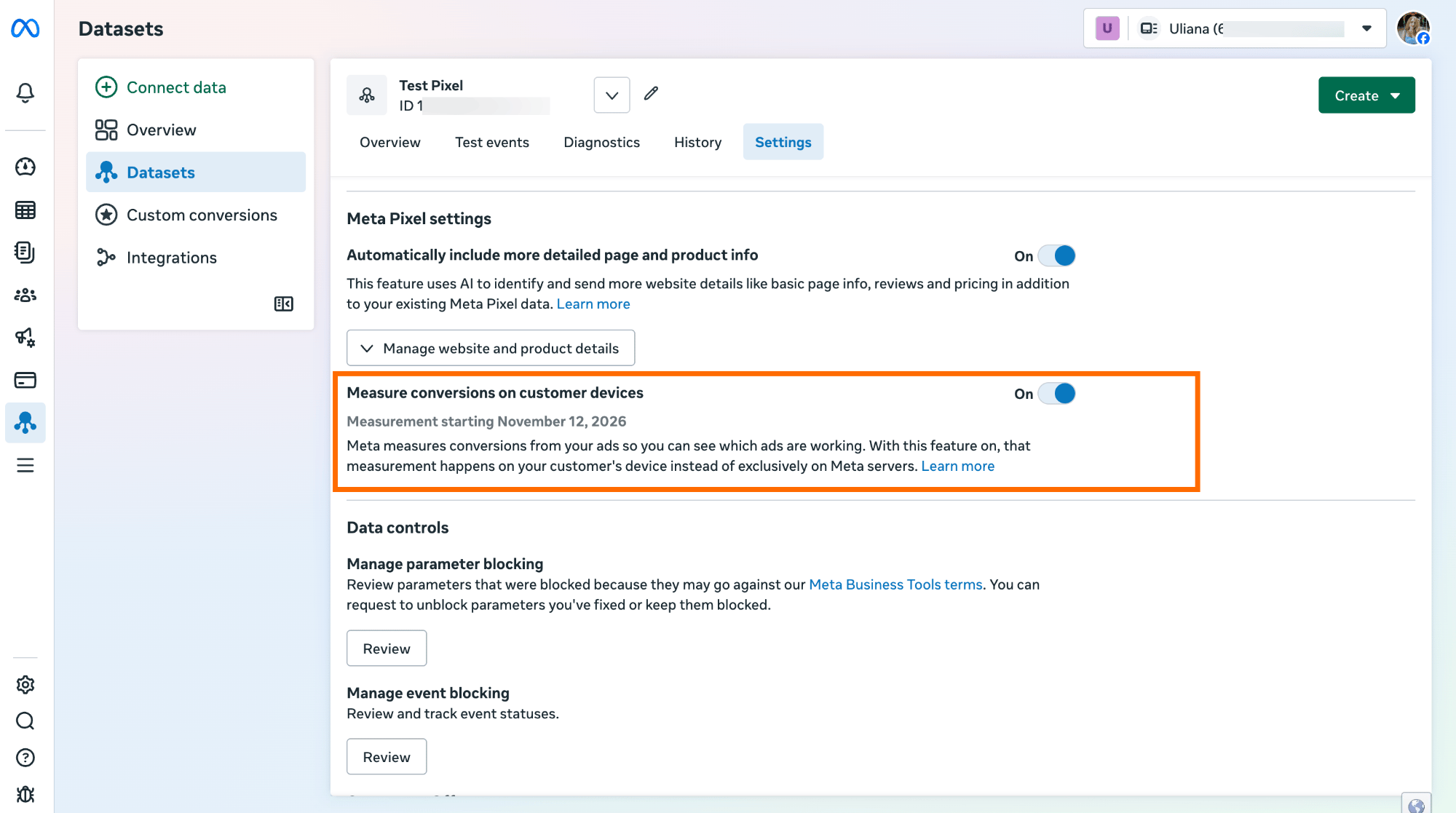
You can also disable the feature if needed. According to Meta's documentation, the setting is enabled by default for eligible advertisers. To see the feature status, go to your Events Manager → open the Pixel → Settings tab.
The feature is scheduled to roll out on November 12, 2026. Meta also states that it is not active for people located in the EU and UK.
How the release may impact the data
The advertisers may see an increase in attributed conversions and reported conversion value. As a result, reported cost per acquisition (CPA) could decrease and return on ad spend (ROAS) could increase, even if actual sales and advertising spend remain the same.
An increase in attributed conversions does not necessarily mean an increase in the actual number of conversions. It may mean that Meta can associate more existing conversions with the ad campaigns you run.
What it means for server-side tracking setups
The new feature will complement existing server-side tracking configuration; it doesn’t replace it.
- Meta Pixel and CAPI will still be necessary for data tracking. The feature is going to work alongside Meta Pixel and CAPI setups.
- No extra action is expected to be required from your side. You do not need to create a new CAPI integration specifically for this feature or enable it manually in Events Manager.
- Attribution settings remain the same. Meta states that the feature does not change the configured attribution window or attribution model.
Meta’s documentation doesn’t explain how on-device match interacts with server-delivered events. So, a recommended approach is to monitor the reporting after rollout and investigate unexpected changes.
Was this article helpful?
Recommended for you
Blog
Meta attribution inaccuracy troubleshooting and fixing
Meta attribution can be inaccurate due to missing fbc/fbp, cookie restrictions, ad blockers, or misconfigured setups. Learn how to troubleshoot and fix it.
May 6, 2026

Comments