7 extra services every marketing agency should offer in 2026

Maryna Semidubarska
AuthorKey takeaways:
What services do digital marketing agencies usually offer?
Most digital marketing agencies start with the classic service list. They help clients with SEO, paid ads, social media, email marketing, content, landing pages, and reporting. Some agencies also offer branding, website design, CRO, and marketing strategy.
This is a good base. Clients need these services. But this is not enough, as many agencies offer the same services. The client looks at five websites and sees almost the same promise everywhere: more traffic. More leads. More sales.
That is why the next step is adding services that solve more difficult, complex problems. In 2026, clients need help with tracking, AI, reporting, customer data, and profit-based decisions. They want to know what works. They want to know where their ad budget goes. And they want a setup that keeps working when browsers, platforms, and data privacy laws change. That is where an agency can move from "we run your ads" to "we help you understand and grow your marketing system."
How can a decent digital marketing agency become the best one?
In 2026, clients can use AI tools to write posts, build simple landing pages, and make first drafts of ads. The value of an agency is no longer just production. The value is a correct setup and complete data.
Seth Godin explains this through specialization. He writes that people do not want someone who is pretty good at one thing and also good at other things. They want someone who is the best at what they are doing. For agencies, this means your extra services should not feel random.
Your services should answer real client needs, like:
- We do not trust our conversion data.
- We spend money on ads, but we cannot see a profit.
- Our team uses AI, but the output is unclear.
- We want to appear in AI results, but we do not know how to track whether traffic comes from there.
- We have many tools, but no good reporting.
The best agencies package these problems into services that clients can understand and buy.
7 extra services that can increase your agency revenue in 2026
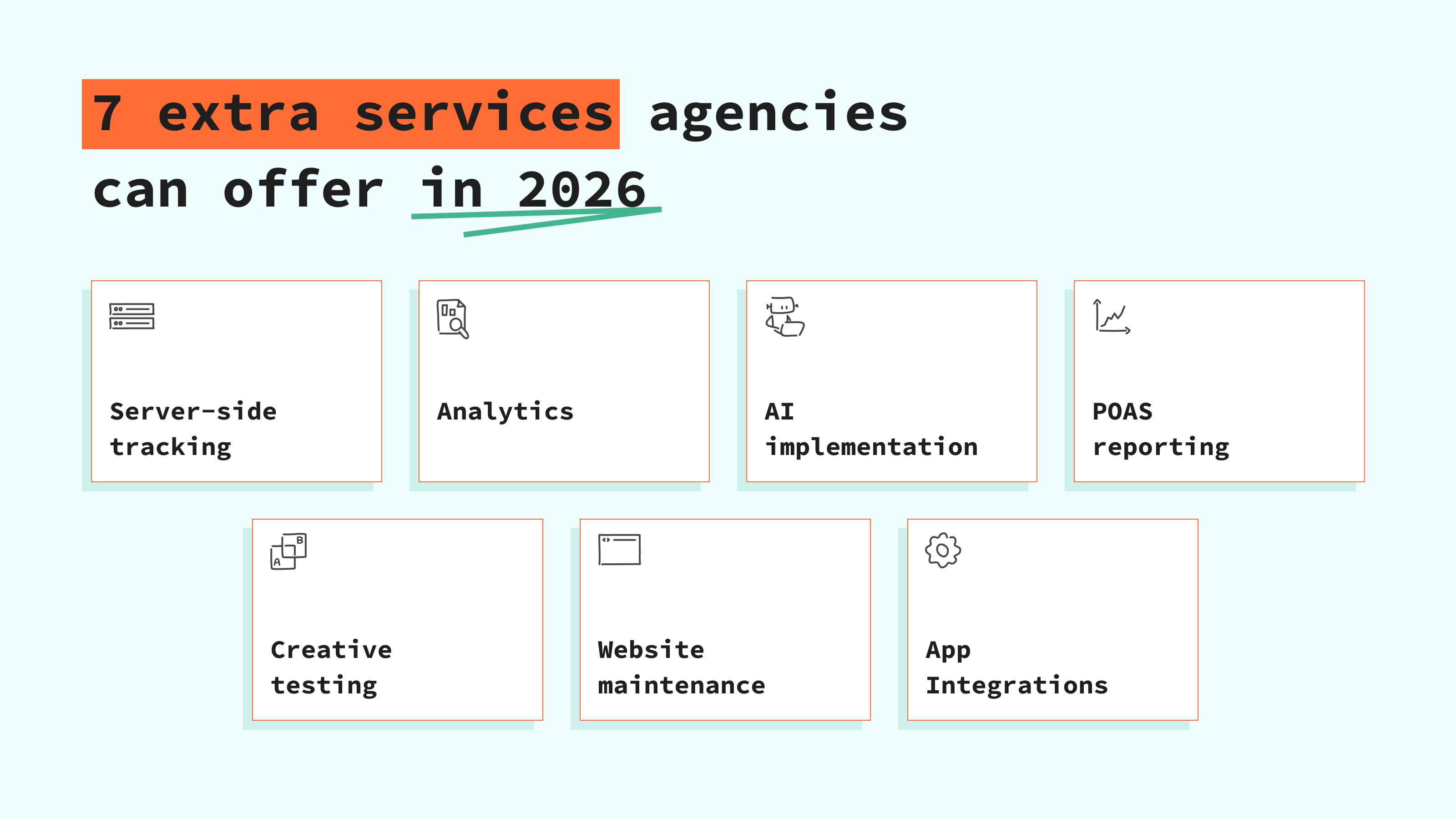
1. Server-side tracking implementation
Server-side tracking is one of the strongest extra services an agency can offer in 2026. In a basic web tracking setup, the browser sends data straight to tools like GA4, Google Ads, or Meta. With server-side tracking, the event still starts on the website, but it first goes through a server Google Tag Manager (sGTM) container running on a cloud server. From there, it is sent to the platforms you choose. This gives the client more control over data flow.
This way, an agency can help a client:
- Set up event sending to Meta, Google, TikTok, Snapchat, or other destination platforms.
- Set up a custom subdomain like anything.yoursite.com.
- Debug the setup before launch.
- Support the setup after launch.
As a result, clients get more complete conversion data, more control over what data is shared with each platform, and clearer tracking reports. This makes the service valuable for clients who do not know how tracking works but see the business problem: missing conversions, weak reports, and ad platforms that do not get enough signals.
You can offer server-side tracking as:
- A one-time setup.
- A monthly tracking support service.
- A tracking audit plus implementation.
For agencies, Stape offers an Agency account made for client work. In this account, you can create or invite client accounts, manage access, and keep client billing easier to control.
2. Data-driven marketing and analytics
Many clients have data, but they do not know what to do with it. They have GA4 reports, ad platform reports, CRM data, and website data. The problem is that these numbers are often separated. The client sees many dashboards, but not one clear answer.
Data-driven marketing and analytics help fix that. As an agency, you can turn raw numbers into decisions, show campaign performance, check conversion rates, and measure ROI.
You can package this service around:
- Paid ads reporting.
- Monthly performance reports.
- Revenue and ROI analysis.
- Next-step recommendations.
This way, the client does not only get numbers. They get a clear view of what works and what should be changed next.
3. Artificial Intelligence (AI) integration in marketing campaigns
AI is already part of marketing work. Clients use it for content ideas, ad drafts, email copy, research, and reports. But many teams use AI without a clear process. This creates messy output, without any brand voice, and content that still needs too much editing.
This is why AI integration becomes a paid service.
You can help clients:
- Build prompts for ads, emails, and landing pages.
- Create AI workflows for campaign planning.
- Set rules for brand voice.
- Use AI for report summaries.
- Build content briefs faster.
- Test more ad angles.
- Keep human review in the process.
The client does not ever need "AI content"; they need a marketing process where AI saves time, but the team still controls quality.
4. Profit-based reporting
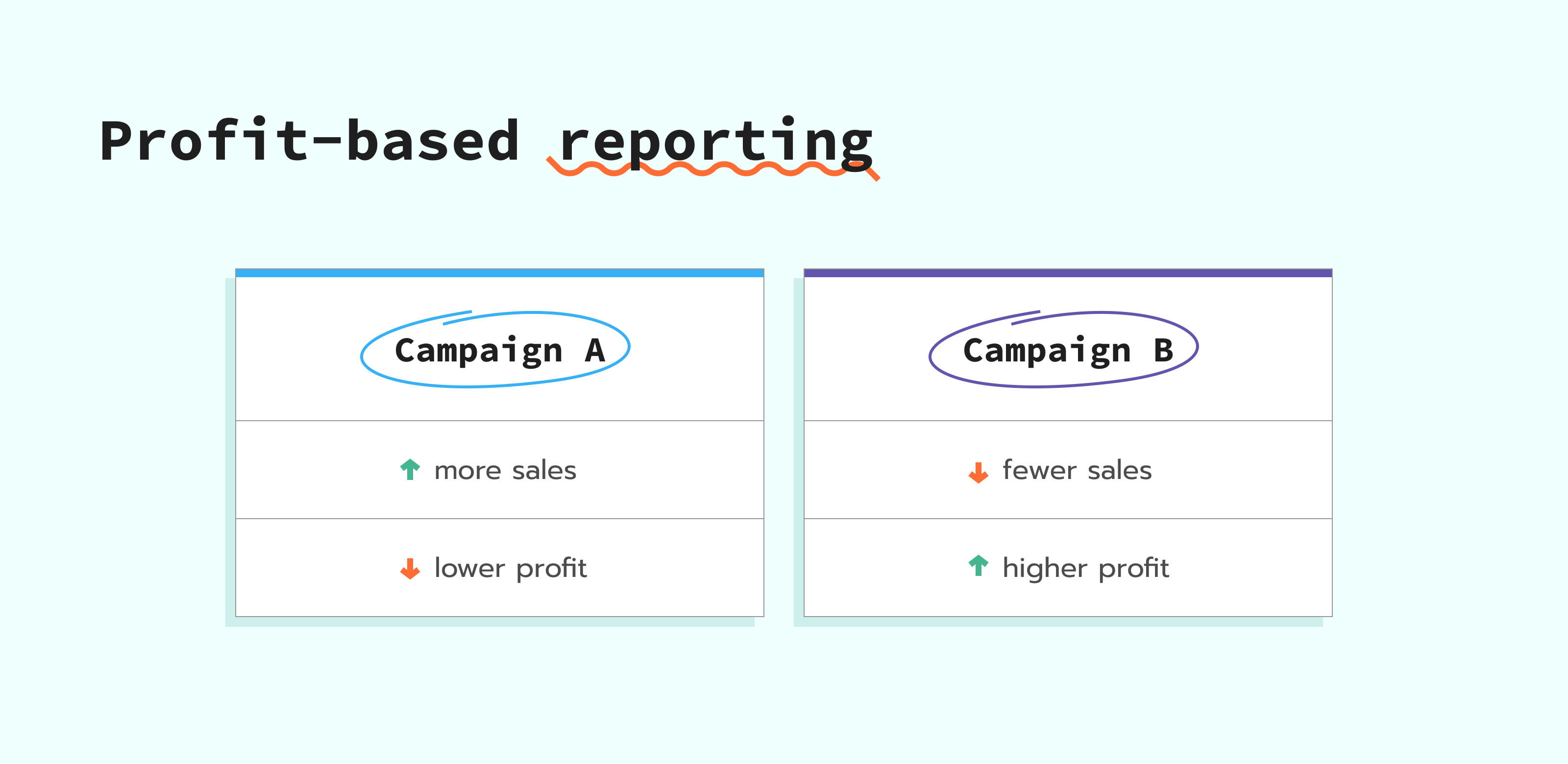
Revenue is useful, but profit helps to understand how to manage marketing campaigns. An eCommerce client can have high revenue and still lose money if ads push products with low margins. That is why agencies can offer profit-based reporting as an extra service. This service helps clients see which campaigns bring profitable sales, not only sales.
You can support this service with POAS Data Feed by Stape, which sends profit or margin values to analytics and ad platforms instead of only revenue which is very useful for eCommerce brands. For example, a client can see that one campaign brings many orders, but most of them come from low-margin products. Another campaign brings fewer orders, but those orders include high-margin products. That second campaign can be more valuable for the business.
This service is useful because it helps clients understand where to put more budget. They can see which campaigns bring more profitable sales and which campaigns only bring revenue without enough margin.
5. Creative testing system
Many clients still treat ad creative as a feeling game. They make a few visuals, run them, and wait. If the campaign works, nice. If it does not, they start guessing.
A creative testing system turns this into a process.
The agency can build a service that includes:
- Creative angles.
- Hook testing.
- Landing page message testing.
- Weekly creative review.
- A test plan.
- Reporting on what message works.
6. Website maintenance and conversion support
Many clients think their website is finished after launch. Then plugins break, pages load slowly, and tracking breaks. The client notices only when leads drop or customers complain.
That is why website maintenance is a strong recurring service. Agencies can offer uptime monitoring, regular backups, support tiers, and care plans.
You can make this service more valuable by adding conversion support. This means you not only keep the website alive. You also help it work for marketing.
You can offer:
- Form checks.
- Page speed checks.
- Plugin and theme updates.
- Landing page edits.
- Checkout checks for eCommerce sites.
- Monitoring setup to receive alerts when something unusual happens in the sGTM container.
- Regular checks of tracking issues in logs and event flow.
This way, the client gets fewer website and tracking problems, while the agency gets a clearer recurring service to offer after the first setup.
7. Apps integrations and marketing automation
Many clients use too many disconnected tools. Their website, CRM, email platform, forms, calendar, payment system, and ad platforms do not always talk to each other, which creates manual work and lost data.
Agencies can help clients connect CRM and CMS data with their tracking setup. Stape apps support integrations with platforms like Pipedrive, Salesforce, HighLevel, WordPress, Shopify, Wix, and other tools.
You can also connect:
- Website forms with CRM.
- Lead forms with email flows.
- Payment tools with customer lists.
- Booking tools with sales teams.
- eCommerce platforms with reporting tools.
- Internal alerts with campaign actions.
For example, when someone fills out a form, the lead can go to the CRM, trigger an email, notify the sales team, and appear in the monthly report. The client does not need to move data manually, and the agency becomes the team that keeps the marketing system connected.
FAQs
What is a full-service digital marketing agency?
A full-service digital marketing agency helps clients with most parts of online marketing. This can include SEO, paid ads, email marketing, social media, content, website updates, reporting, and strategy. Some full-service agencies also offer tracking setup, CRO, lifecycle marketing, and data dashboards.
A strong full-service agency does not just "do everything." It connects the work into one system. For example, ads bring traffic. Landing pages turn traffic into leads or sales. Tracking shows what worked. Reports help the client decide what to do next.
What is the future of digital marketing in 2026?
The future of digital marketing in 2026 is more technical, more data-focused, and more AI-assisted. AI will help teams create, test, and analyze faster. But brands will still need a clear strategy, strong creative judgment, correct tracking, and trusted data.
AI agents and GenAI-powered tools will change channels, execution, content, and data governance in marketing. This means agencies need to move past basic execution.
Clients will need help with:
- Server-side tracking.
- AI workflows.
- More complete data.
- Profit-based reporting.
- Creative testing.
- Customer retention.
The agency that helps clients understand what is happening will be more valuable than the agency that only publishes campaigns.
What are the main rules in marketing?
The main rule in marketing is simple: understand who you serve and what change you help them make.
You need to know:
- Who the customer is.
- What problem they have.
- Why they should care now.
- What offer solves the problem.
- Which channel reaches them.
- What data proves the result.
This is why extra services matter. A strong agency helps the client see the full path from click to revenue, from revenue to profit, and from first purchase to repeat customer.

Comments