2.2% more GCLIDs recovered on Safari iOS 26 with Query Replacer | Lars Friis
Written by
Anastasiia Chorna
Lars Friis, a long-time Stape partner and Danish tracking expert with 10+ years in e-commerce and marketing, helped a client solve one of today’s biggest tracking challenges: Safari removing click identifiers like the Google Click ID (GCLID).

Challenge
Starting with iOS 17, and now with iOS 26, Safari's Intelligent Tracking Prevention (ITP) removes GCLID click ID parameters from URLs in Private Browsing. This creates several issues:
- Broken attribution – clicks can’t be tied to conversions if the GCLID disappears.
- Unreliable ROAS – Google Ads shows incomplete data.
- Poor bidding signals – Smart Bidding algorithms receive less accurate feedback.
For the client, this meant conversions from private Safari browsers were unattributed, lowering confidence in campaign performance.
Platforms involved + solution
To resolve the issue, Lars Friis brought together three key platforms, each playing a specific role in the tracking setup:
- Google Ads – this is where click IDs (GCLIDs) originate. In Google Ads, the standard GCLID is removed by the browser, so it can be replaced with a custom parameter to preserve tracking until conversion.
- GA4 / Google Analytics – used to measure conversions and user behavior. GA4 relies on identifiers like the GCLID to tie actions back to campaigns, so its accuracy depends on those IDs being intact.
- Stape’s Query Replacer – a key tool in this setup. It runs in the server-side GTM container to preserve and replace URL parameters, ensuring that important tracking identifiers like GCLIDs remain intact even if browsers or ad blockers try to remove them.
With guidance from Lars Friis, the client company configured Stape Query Replacer to:
- Recreate missing GCLIDs automatically, ensuring fewer clicks went unattributed.
- Maintain accurate server-side tracking, storing the GCLID in a durable first-party cookie under their control.
- Bypass common browser restrictions, like ITP and ad-blockers, without building a complex custom solution.
The full process is documented in our step-by-step guide, showing exactly how to implement the setup to recover lost GCLIDs.
What stood out was how quick and practical the process was. The entire setup took about 30 minutes – no heavy coding, no large development resources – yet it delivered measurable improvements in attribution accuracy almost immediately.
Results in numbers
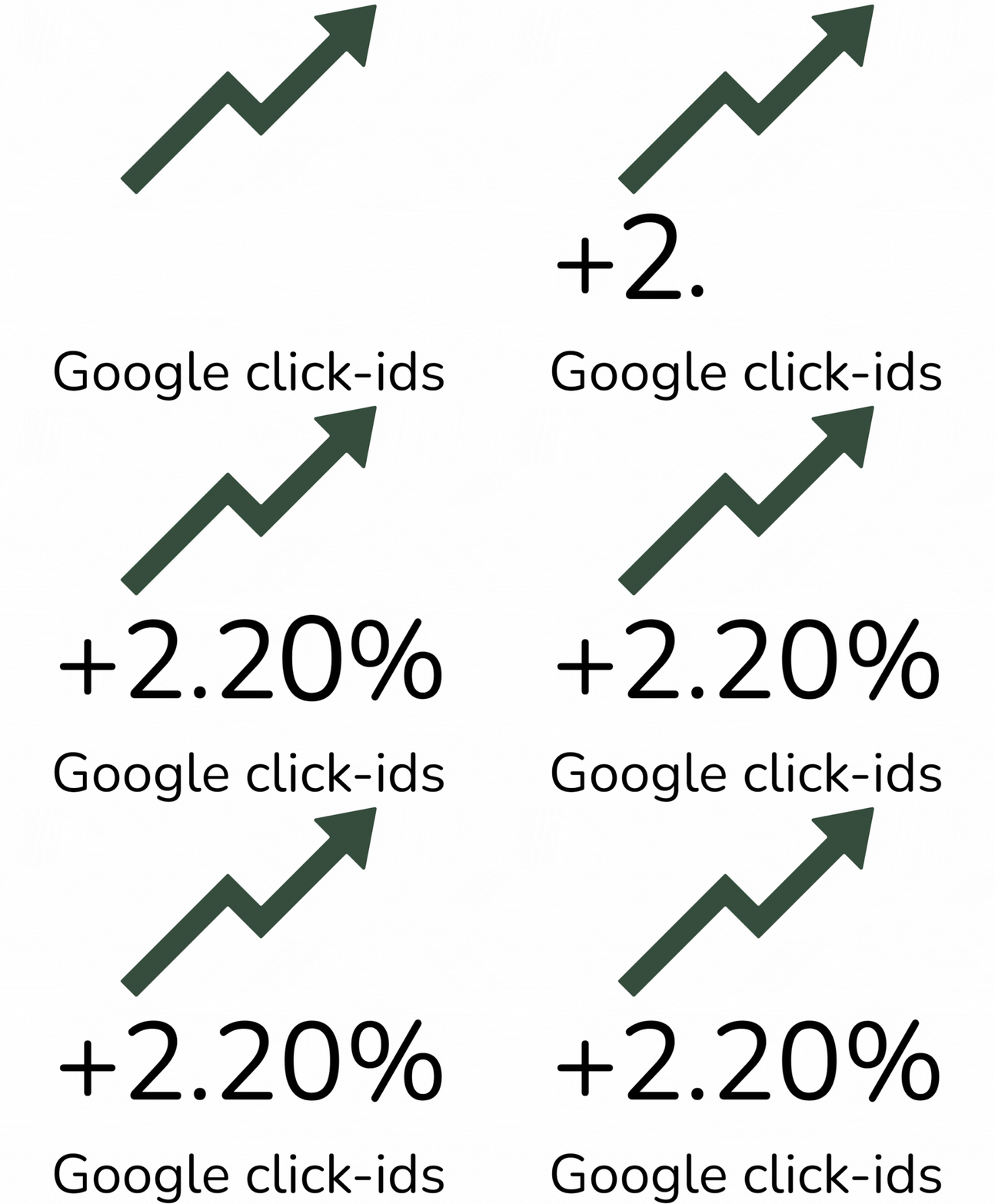
- +2.20% more GCLIDs captured
- 1,097 click IDs recovered out of 50,000
- Setup time: ~30 minutes
Even a small percentage of recovered GCLIDs had a measurable impact on attribution accuracy, ROAS reporting, and Smart Bidding effectiveness.
Conclusion
Safari iOS 17 Private Browsing removed GCLIDs, breaking attribution and impacting campaign accuracy. The client’s company, guided by Lars Friis, implemented Stape’s Query Replacer in a server-side GTM container to preserve and recreate missing identifiers, achieving measurable improvements with minimal setup.
Key Takeaways
- The problem: Safari iOS 17 stripped GCLIDs, causing unattributed conversions and weaker Smart Bidding signals.
- The solution: server-side setup using Stape’s Query Replacer to store and recreate GCLIDs.
- The result: +2.2% more GCLIDs recovered (1,097 out of 50,000) in ~30 minutes.
- Results vary depending on Safari usage and the share of sessions in Private Browsing – higher usage means a larger portion of click IDs can be recovered.
- Important note: please remember to respect users who decline cookies. Always ensure that their preferences are honored, and no tracking occurs if they’ve opted out.
Why choose Stape
- Purpose-built server-side tools like Query Replacer.
- Quick setup with no heavy coding.
- Reliable tracking unaffected by ITP or ad blockers.
- Expert support with proven real-world case studies.
Special thanks to Lars Friis for sharing his expertise and contributing to this case study.
Want to try on the server side?
Try for freeWas this article helpful?
Recommended for you
Oct 21, 2025
Case studies
36% more conversions with server-side Google Ads tracking for Shopify | Lars Friis
Server-side tracking helped Lars Friis’ client track 36% more conversions in Google Ads compared to Shopify's Google App. Check how the result was achieved.
Sep 24, 2025

Comments