Stape for agencies: how to pitch server-side tagging to clients who don't care at all about tagging
Written by
Josh Silverbauer
Key takeaways:
- Sell outcomes, not architecture: usually, clients aren't interested in the technical concepts behind server-side tagging (and that's fine). What they care about is revenue, leads, and whether their ad spend is actually working.
- Acknowledge the data leak: standard client-side tracking is likely losing 15–40% of conversion data due to browser restrictions and ad blockers, which means ad algorithms are making budget decisions based on an incomplete picture.
- Position data recovery as a ROAS driver: recovering lost conversions gives ad platforms accurate data to work with, leading to smarter optimization, lower CPA, and better ROAS without spending an extra dollar on ads.
- Highlight the performance boost: moving tags to the server reduces the number of scripts firing in the browser, which means faster page loads and, consequently, more conversions.
- Emphasize data control and privacy: server-side setups give businesses direct control over what gets shared with third-party platforms, which reduces compliance and privacy risks.
- Use Stape for agency growth: Stape simplifies server-side deployment and multi-client management, while its partner program allows agencies to turn a technical setup into a reliable, recurring revenue stream.
Here's the thing about server-side tagging: we love it. We think it's great. We could talk about sGTM containers and first-party cookie extensions and Conversions API pass-throughs all day long. Ever been to a server-side dinner party…that's a stumble out at 3 am night.
Your clients? They'd rather watch paint dry than hear you talk about it. Actually, no, they'd rather watch paint dry while sitting in a meeting about paint drying. That's how little they care about your tagging architecture - 0%.
And you know what? That's totally fine. They shouldn't have to care. Your clients care about money. They care about leads. They care about whether that $40K/month in ad spend is actually doing something good. And the beautiful irony here is that server-side tagging is one of the most impactful things you can do for those concerns.
You just have to stop talking about it like an engineer and start talking about it like someone who wants a client to understand.
The problem: your data is lying to you
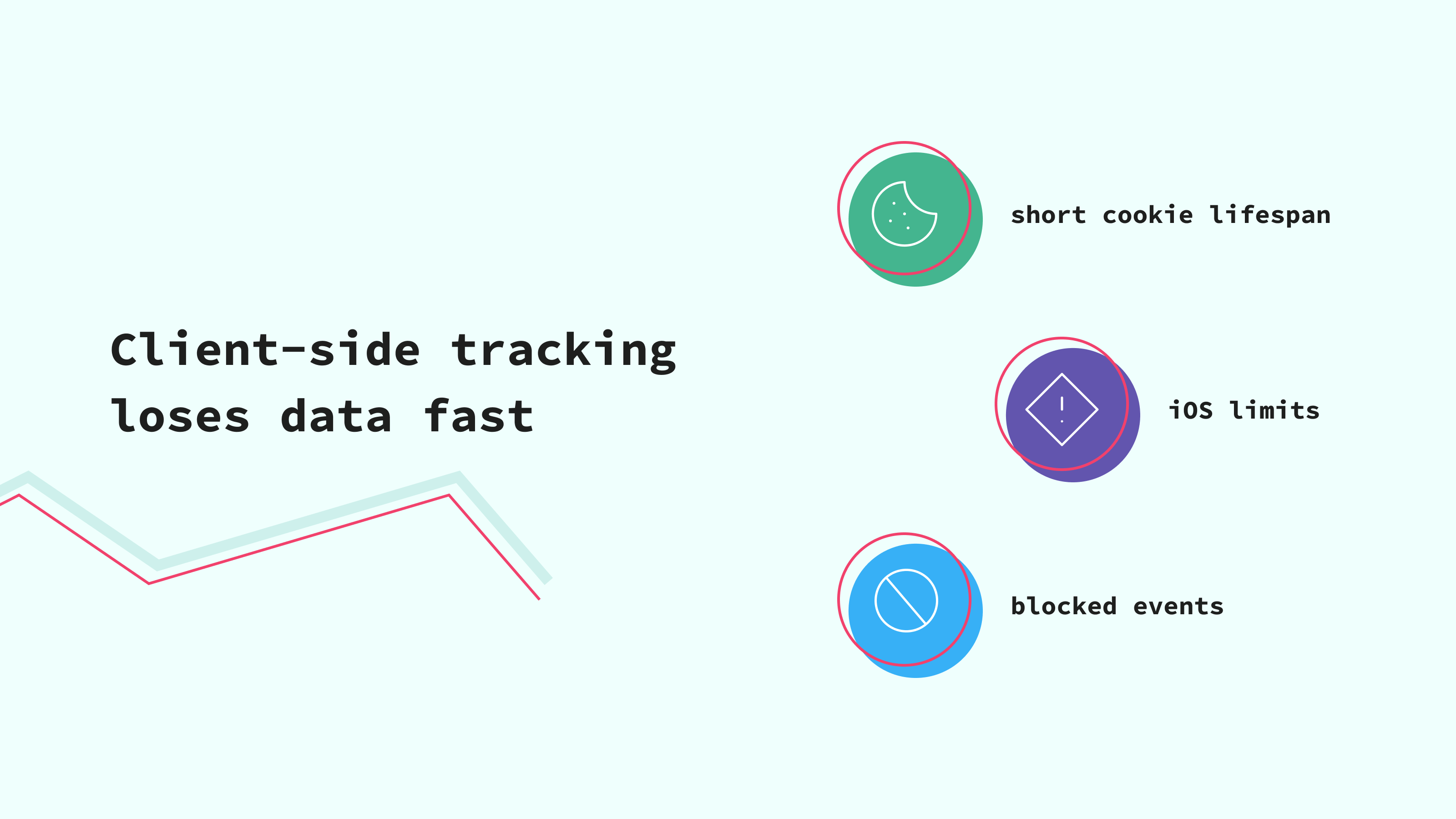
Right now, your client's tracking setup is almost certainly losing data. Browsers are actively working against you. Safari caps cookie lifetimes at 7 days (sometimes less). Ad blockers are blocking tracking scripts before they even fire. ITP, ETP, and every other acronym ending in "P" are making it harder for your client-side tags to do their job.
What does that actually mean in practice? It means conversions are going unreported. It means Google Ads, Meta, and every other platform are getting incomplete data back, which means their algorithms are optimizing on bad information. It means your attribution reports are bunk.
I'd estimate that most client-side-only setups are missing somewhere between 15-40% of their conversion data. That's not a rounding error. That's a massive, budget-shaping blind spot.
The translation: stop saying "server-side" and start saying "money-side"
Here's where Stape comes in, and here's how to actually pitch it without watching your client's eyes glaze over in the first 30 seconds.
What NOT to say:
"We need to implement a server-side Google Tag Manager container that proxies your tracking requests through a first-party subdomain, extending cookie persistence and bypassing browser-based tracking prevention mechanisms."
(One of my counted sheep died of boredom while I fell asleep saying this)
What TO say:
"Right now, your ad platforms are missing a significant chunk of the conversions they're actually driving. That means they're optimizing your budget based on incomplete information. We can fix that, and it'll directly improve your return on ad spend."
Same concept. One of them gets a head nod and a "tell me more." The other gets a "can you send that in an email" (which is client-speak for "I will never read this").
The business case: four things your client actually cares about
When you're pitching Stape (or server-side tagging in general), anchor every single talking point to one of these three outcomes.
1. More accurate conversion data = smarter ad spend
When you move your tracking through a server-side setup like Stape, you're recovering conversions that would otherwise not be there. Stape's Cookie Keeper extends first-party cookie lifetimes beyond Safari's 7-day cap. Their Custom Loader makes your tracking scripts harder for ad blockers to detect and block (and just a nod that you should have consent on your site, and if they opt out, don’t track them, but this is for the auto-ones). The result? More conversions show up in your reports, not because more people are converting, but because you're counting the ones that were already happening.
For your client, this means their Google Ads account, their Meta campaigns, and their LinkedIn conversion tracking efforts all get a more complete picture of what's working. And when the algorithms have better data, they make better optimization decisions. Better optimization = lower CPA = happier CFO. Happy client. You celebrate.
Real-world proof? Stape has case studies showing a 40% reduction in misattributed Direct traffic after implementation, with corresponding lifts of 9-13% in properly attributed revenue across channels like Google Ads and email. That’s huge.
2. Better ROAS (without spending more)
Here's a fun pitch line: "What if I told you I could improve your return on ad spend without increasing your budget by a single dollar?"
That's what accurate conversion data does. When Meta's algorithm can see that a campaign actually drove 30% more purchases than it was previously tracking, it starts allocating budget more effectively. You're not spending more, you're spending better because the machine learning finally has a better picture.
I've seen this play out across clients in eCommerce, lead gen, and SaaS. The return on ad spend (ROAS) improvement from better data often dwarfs the cost of the server-side infrastructure. And with Stape, we're talking about a starting cost of around $20/month per client. Twenty bucks. That's less than your client spends on that taco bar lunch that gets mediocre enthusiasm from their teams.
3. Faster website = more conversions
This one is a nice bonus that a lot of agencies overlook in their pitch. When you move tags server-side, you're pulling heavy third-party scripts out of the browser. Fewer scripts firing client-side means faster page loads. Faster page loads mean better user experience. Better user experience means more conversions.
Your client doesn't need to understand the technical mechanism. They just need to hear: "This will also make your website faster, which we know leads to more sales." Done.
4. You are in control
People don't like getting sued. With a good server-side setup, you control the data going to the end platform. You can see every request and tailor what gets sent, which means you can control what third parties receive. Don't want to send Facebook IPs? Great! Don't do it. If you are a regulated business or in a regulated country or state, controlling the data exchanges becomes absolutely necessary, and server-side gives you that control.

Why Stape specifically?
There are several ways to do server-side tagging. You could host your own containers on Google Cloud or AWS (annoying). You could go with various providers (not as good). But here's why Stape makes the most sense from an agency perspective:
It's built for agencies managing multiple clients. One dashboard, flexible billing per client, role-based access, custom notifications. If you've ever tried to manage 15 different GCP projects for 15 different clients, you know why this matters. (If you haven't, only try this if you enjoy masochism.)
The partner program is genuinely good. Stape offers up to 40% lifetime commission on every hosted client. So the server-side implementations you sell today become a recurring revenue stream for your agency. That's not just a nice-to-have, that's a fundamentally different business model than the one-and-done setup fee.

The tools make your life easier. Setup is super duper simple. Just add the container code and set up payment, and boom, you have a server-side GTM container.
The bottom line
Server-side tagging is one of those things in our industry that is simultaneously very technical and very high-impact for business outcomes. The mistake most agencies make is leading with the technical side and wondering why clients aren't excited.
Lead with the business outcomes, more accurate attribution, better ROAS, faster site performance, privacy resilience, and bring in the technical architecture only when (and if) the client asks how you're going to deliver on those promises.
Stape makes the delivery side easier than it has any right to be. Your job is to make the value side impossible to ignore.
Now go, you little engineer you, make everyone some money.
Want to start on the server side?
Try for freeRecommended for you
Nov 7, 2025
Blog
How to prove server-side tracking ROI to clients and stakeholders
Show server-side tracking ROI to clients with clear guardrails, before/after or A/B methods, and proof layers in Requests Analytics, GA4, and ad platforms.
Sep 30, 2026

Comments