Report HighLevel Opportunity statuses to required platform with Stape

Uliana Lesiv

Uliana Lesiv

Author
Updated
May 14, 2026

Stape Conversions Tracking HighLevel CRM app is the tool that allows you to send Opportunities' statuses from HighLevel CRM to platforms such as Meta, Google Ads, or others that support server-side tracking. Also, it sends data on offline conversions to the platform. This data is later used for campaign optimization and targeting the audience that is likely to convert.

App use cases

The Stape's app will be a useful solution for the following needs:

  • Improve Facebook Lead Ads campaign performance. The purpose of Facebook Lead Ads is lead acquisition through a lead ad on the Meta platform. A user submits a form, and then the form data is automatically transferred to Highlevel CRM, allowing you to follow up with prospects interested in your product or service. Stape's app then sends updates on Opportunities' statuses to the Meta Dataset. Meta uses this data to optimize campaigns and target audiences that can convert into purchases. Lead acquisition marketing strategies can help you get more out of every form submission.
  • Optimize Google Ads campaigns. If you run campaigns on Google Ads, Stape's app can supply the platform with data on Opportunities' statuses after they interact with the ad. Our solution will automatically create a Customer Match list in Google Ads.
  • Send HighLevel data to specific platforms. If you use a server GTM container and configure the app with it, you can transfer data from HighLevel to any platform that supports server-side tracking.
  • Track offline conversions. Some businesses have a lot of conversions that are made offline. Their marketing funnel starts with online promotions on the ad platform and generates many purchases through phone calls, online meetings, or physical store visits. Once the purchase record is added to the CRM, Stape’s app automatically sends the data to Meta/Google Ads Customer Match list.
  • Update Meta Custom Audience automatically. With Stape’s app, you can manage Meta audiences directly from the server. The app communicates with the Meta Marketing API to add or remove users from specific Custom Audiences in real-time. In this way, your user data will always be up to date without any manual actions from your side.

Benefits of Stape's app for HighLevel CRM

BenefitWhat do I get?
No need for manual CVS files uploadThe app will automatically send conversion data from HighLevel CRM to Meta or Google Ads; there is no need for any manual actions from your side.
Meta and Google Ads campaign performance improvementWhen the platforms receive data from a CRM account, they can analyze how different audience segments behave after interaction with the ad and target the users who are more likely to convert.
Offline conversions trackingYou can send data from HighLevel CRM on conversions that happened in physical stores, during phone calls, directly to Meta to improve audience targeting.
Multiple app integration methodsThe app provides different integration methods that best suit your needs: Meta Conversions API Gateway, Signals Gateway, or server GTM.

How to configure Stape Conversions Tracking HighLevel CRM app

App installation

Before you start

Make sure you have a sub-account on HighLevel.

You can find your sub-account on the left-hand side of the panel in the section Sub-Accounts.

If the page Sub-Accounts is empty, click the Create Sub-Account button in the top-right corner → choose account typechoose a snapshotadd your client's addressSave.

Installation process

Install Stape Conversion Tracking HighLevel app on HighLevel's marketplace.

Select a sub-account you want to install the app on.
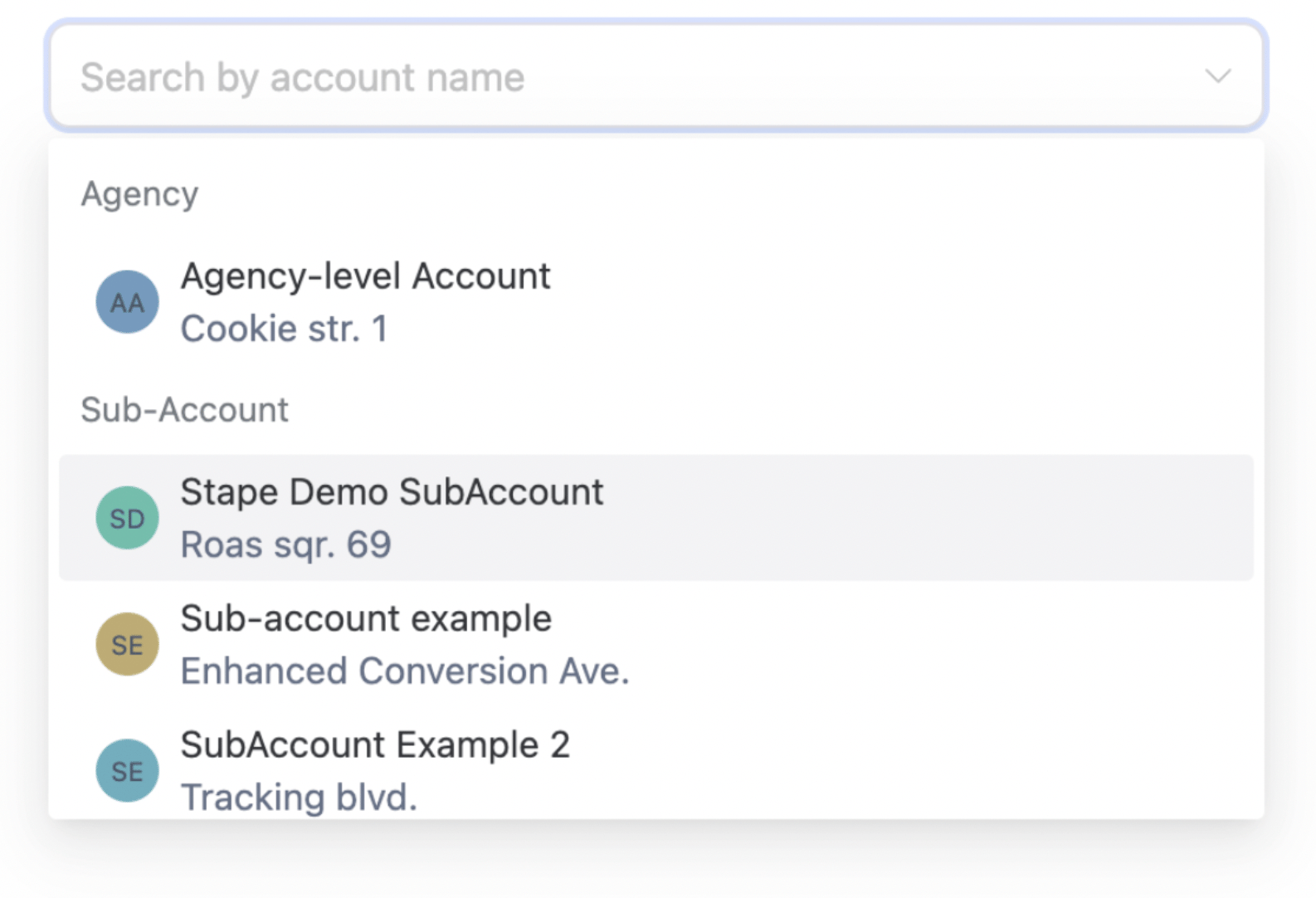
Select a sub-account you want to install the app on

Integration methods and their differences

The HighLevel CRM app by Stape provides 5 different integration methods for sending lead and opportunity data to your marketing platforms.

Note: You can configure multiple tabs/methods; each one runs on its own.

Meta Conversions API Gateway (CAPIG)

This integration is built for Meta platforms such as Facebook and Instagram. It sends CRM event data directly to the Meta Conversions API.

Meta CAPIG is best for users who only need to track offline conversions and events in Meta. It is the most direct and simplest way to connect CRM data to Meta, but it is limited to Meta’s ecosystem.

Signals Gateway

Signals Gateway is the unified routing solution. Instead of sending data separately to each platform, you send it once to Stape and then distribute it to multiple destinations.

Signals Gateway is best for users who, besides Meta, want to connect a few other platforms and look for a balance between simplicity and flexibility. Signals Gateway is more powerful than CAPIG (as it provides the option to add other platforms), and easier to configure than server-side GTM.

Server Google Tag Manager (sGTM)

This method integrates directly with your server-side Google Tag Manager container. It gives you full control over how data is processed and routed.

Server GTM is best for tracking setups that require custom logic or integrations with other platforms that Signals Gateway doesn’t provide. It offers the highest level of customization and control, but requires more technical setup and ongoing management.

Customer Match (Google Ads)

It sends CRM audience and contact data directly into Google Ads, where it is used to create and update Customer Lists for targeting and remarketing.

Customer Match is best for users who run Google Ads campaigns and want to build and automate Google Ads audiences based on CRM activity, such as leads, opportunities, and customer lifecycle stages.

Meta Custom Audiences

The method focuses on syncing CRM data to Meta Custom Audiences for retargeting and segmentation. Once configured, it sends data about users who have already interacted with your website or CRM into Meta, so you can target them based on their stage in the customer journey.

Meta Custom Audiences is best for advertisers who want to retarget and re-engage users who have already interacted with their business.

Configure the app based on the configuration method
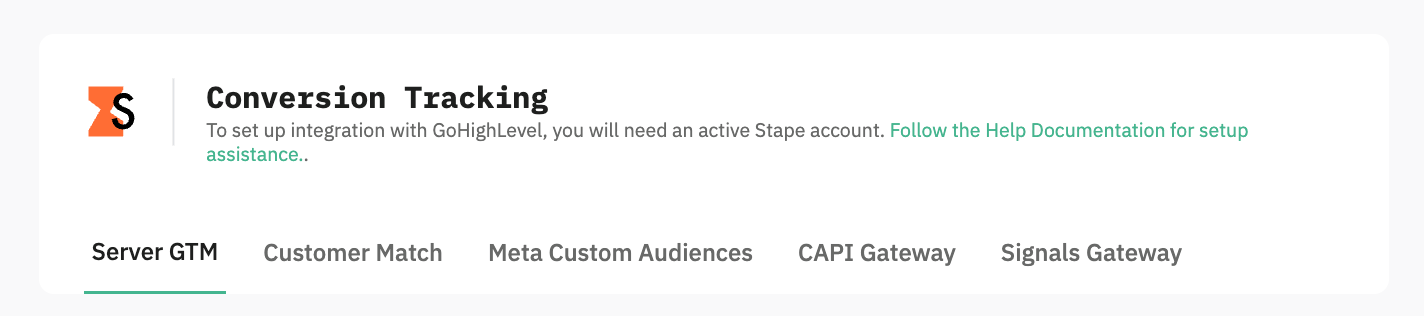
Configure the app

App setup

The setting process can be divided into two parts:

  • Meta and Stape accounts data
  • HighLevel CRM fields
App setup

Meta and Stape accounts data

You will need to fill in the following fields:

- Integration - switch Activate toggler on to enable the current integration (tab) to run in the background.

- Meta Dataset (Pixel) ID - a unique identifier that is used to configure integrations and view events in Events Manager. You can find it in your Meta account in Data Sources' Settings tab. See the detailed instruction on how to find Meta Dataset (Pixel) ID.

- CAPIG API Key - an alphanumeric string value that is needed for app identification. Find CAPIG API Key in the CAPIG settings section of your Stape account. See the detailed instructions on where to find CAPIG API Key.

If you haven't set up Meta Conversions API Gateway yet, see the section above.

CAPIG API Key

HighLevel CRM fields

Next you need to map your CRM fields to conversion event parameters.

- (Optional) Pick a field where Meta Lead ID is stored. Note dropdown will only reflect custom fields.

- Configure additional User data you'd like to send to Meta, by choosing a parameter in the left dropdown and selecting an appropriate field in the right-side one.

HighLevel CRM fields

- Application sends conversion Events based on stages of your Opportunities, whenever an opportunity reaches a stage you define, a corresponding event will be sent towards your Meta Dataset (Pixel). So we need to configure it by choosing one of two approaches:

  • In the left-side dropdown, select an Opportunity stage to trigger an event. In a box to the right, type the event name you'd like to send to Meta.
Opportunity stage
  • Select the Send all stages checkbox if you want to send all Opportunity stages as events to Meta. Events are then named automatically and consist of Pipeline + Opportunity stage name. You can also select stages to ignore in this case.
Send all stages

Once done, click Save and Connect. Once you see a success message your installation is complete and the application will send conversion events in the background based on your settings.

Save and Connect

App setup

The setting process can be divided into two parts:

  • Signals and Stape accounts data
  • HighLevel CRM fields
App setup

Signals and Stape accounts data

You will need to fill in the following fields:

- Integration - switch Activate toggler on to enable the current integration (tab) to run in the background.

- Signals Gateway Pixel ID - a unique identifier that is used to configure integrations and view events in Signals Gateway. You can find it in your Signals Gateway account in the Data Sources tab. See the detailed instruction on how to find Signals Gateway Pixel ID.

- Signals Gateway API Key - an alphanumeric string value that is needed for app identification. Find Signals Gateway API Key in the Gateway settings section of your Stape account. See the detailed instructions on where to find Signals Gateway API Key.

Signals and Stape accounts data

HighLevel CRM fields

Next you need to map your CRM fields to conversion event parameters.

- (Optional) Pick a field where Meta Lead ID is stored.

- Configure additional User data you'd like to send to Meta, by choosing a parameter in the left dropdown and selecting an appropriate field in the right-side one.

HighLevel CRM fields

- Application sends conversion Events based on stages of your Opportunities, whenever an opportunity reaches a stage you define, a corresponding event will be sent towards your Signals Gateway Pixel. So we need to configure it by choosing one of two approaches:

  • In the left-side dropdown, select an Opportunity stage to trigger an event; in a box to the right, type the event name you'd like to send to Signals Gateway pipeline.
Opportunity stage
  • Select the Send all stages checkbox if you want to send all Opportunity stages as events to Signals Gateway pipeline. Events are then named automatically and consist of an Opportunity stage name. You can also select stages to ignore in this case.
Send all stages

Once done, click Save and Connect. Once you see a success message your installation is complete and the application will send conversion events in the background based on your settings.

Save and Connect

App setup

The setting process can be divided into two parts:

  • Stape account data
  • HighLevel CRM fields
App setup

Stape account data

You will need to fill in the following field:

- Integration - switch Activate toggler on to enable the current integration (tab) to run in the background.

- Container API Key - an alphanumeric string value that is needed for app identification. Find Container API Key in the Container settings section of your Stape account. See the detailed instructions on where to find Container API Key.

Stape account data

HighLevel CRM fields

Next you need to map your CRM fields to conversion event parameters.

- (Optional) Pick a field where Meta Lead ID is stored.

- Configure additional User data you'd like to send to server GTM, by choosing a parameter in the left dropdown and selecting an appropriate field in the right-side one.

HighLevel CRM fields

- Application sends conversion Events based on stages of your Opportunities, whenever an opportunity reaches a stage you define, a corresponding event will be sent towards your server GTM container. So we need to configure it by choosing one of two approaches:

  • In the left-side dropdown, select an Opportunity stage to trigger an event; in a box to the right, type the event name you'd like to send to server GTM.
Opportunity stage
  • Select the Send all stages checkbox if you want to send all Opportunity stages as events to server GTM. Events are then named automatically and consist of an Opportunity stage name. You can also select stages to ignore in this case.
Send all stages

Once done, click Save and Connect. Once you see a success message your installation is complete and the application will send conversion events in the background based on your settings.

Save and Connect

If you are using Customer Match as a configuration method for the Stape Conversions Tracking HighLevel CRM app, once configured, a new Customer List will be created in Google Ads. Please note, only Customer Lists created automatically by the Stape connection are supported.

Manually created or pre-existing lists in Google Ads will not be populated. For more info on Customer List, please check our article.

Customer Match

App setup

The setting process can be divided into two parts:

  • Stape and Google Ads accounts data
  • HighLevel CRM fields

Stape and Google Ads account data

You will need to fill in the following fields:

- Integration - switch Activate toggler on to enable the current integration (tab) to run in the background.

- Container API Key - a string used for app identification. Find Container API Key in the Container settings section of your Stape account. See the detailed instructions on where to find Container API Key.

Container API Key
  • Google Ads Operating customer ID - the ID of the Google Ads account where the Customer List will be created or updated. To get it, sign in to your Google Ads account → in the top right corner, click on your picture → copy the value.

Please make sure to remove hyphens before using the string as the Operating customer ID.

Google Ads Operating customer ID
  • Google Ads customer ID - stands for the ID of the account that you're using for authorization. Based on the type of account, you should copy the following values.

- If you're using your customer account, use the customer account ID.

- If you access the customer account through a manager account, use the manager account ID.

Please make sure to remove hyphens before using the string as the customer ID.

Google Ads customer ID

HighLevel CRM fields

Next, you need to map your CRM fields to audience member identifiers.

  • User data - choose the data you want to fill the Custom Audience in Meta with, and specify user and ads data consent status from the drop-down list. 

Please note: Address data will be included only if all four fields (First Name, Last Name, Region, Postal Code) have values.

  • Actions & triggers - choose Action, Opportunity Status, and name a Customer List to be synced to. After configuring Customer Match in the HighLevel app, a Customer List will be created in Google Ads.

Please note: stape_ is always appended, and the name of the list must always start with stape_, e.g., stape_highlevel_purchasers.

  • Backfill - if you check this box, the app will sync existing contacts using the settings in the app above. When the unchecked box is selected, it will sync only new contacts that reach the configured statuses. Unchecking later doesn't remove contacts already synced.

Once done, click Save and Connect. Once you see a success message, your installation is complete, and the application will send conversion events in the background based on your settings.

Save and Connect

If you are using Meta Custom Audiences as a configuration method for the Stape Conversions Tracking HighLevel CRM app, once configured, you will send data on users who have already interacted with your website to Meta. The platform will use the data to target users based on their specific stage in the customer journey.

Meta Custom Audiences

Before you start

1. Make sure you have an active Stape account with a server GTM container hosted on Stape.

If you don't have an account on Stape, please create one or log in if you already have one. In the main menu, click sGTMCreate container on the top right.

Create container

Add your container name, the Container configuration that you copied from your Google Tag Manager Server Container, and select the server location. Click Create Container.

For more detailed instructions, check Stape's article on how to set up a Google Tag Manager server container.

2. Create a custom audience in Meta.

We show how to do it in detail in our guide on Meta Custom Audiences in step 1.

3. Enable the Meta Connection in your Stape admin account.

Open the required container, go to the Connections tab, and click Sign in next to Meta. Use an account that has access to the Meta Ads where you need to update the custom audience.

Meta Connection

App setup

The setting process can be divided into two parts:

- Stape account data

- HighLevel CRM fields

Stape account data

You will need to fill in the following fields:

- Integration - switch Activate toggler on to enable the current integration (tab) to run in the background.

- Container API Key - a string used for app identification. Find Container API Key in the Container settings section of your Stape account. See the detailed instructions on where to find Container API Key.

Container API Key

HighLevel CRM fields

Next, you need to map your CRM fields to audience member identifiers.

  • User data - choose the data you want to fill the Customer List in Google Ads with, and specify user and ads data consent status from the drop-down list. 
  • Triggers & actions - choose Action, Opportunity Status, and Audience ID to be synced to (the custom audience you’ve created in Meta).

To find Audience ID - go to the Audiences section in Meta Ads, click Columns, enable Audience ID, then copy the ID of the required custom audience once the column appears.

Audience ID
  • Backfill - if you check this box, the app will sync existing contacts using the settings in the app above. When the unchecked box is selected, it will sync only new contacts that reach the configured statuses. Unchecking later doesn't remove contacts already synced.

Once done, click Save and Connect. Once you see a success message, your installation is complete, and the application will sync audience members to your Meta custom audience in the background based on your settings.

Save and Connect

To sum up

With the Stape Conversion Tracking HighLevel CRM app, you can easily monitor the progress of your Opportunities and report them as conversion events to your destination.

The setup process is quick and simple with a single-screen interface. You can begin reporting Opportunities' progress to your destination by mapping CRM fields to conversion event parameters in a few easy steps.

Want to start on the server side?Register now!

author

Uliana Lesiv

Author

Uliana is a Content Manager at Stape, specializing in analytics and integration setups. She breaks down complex tracking concepts into clear insights, helping businesses optimize data collection.

Comments

Try Stape for all things server-side