HubSpot app by Stape: report data from CRM to the platforms you need

Uliana Lesiv

Uliana Lesiv

Author
Updated
Feb 20, 2026

The Stape Conversions Tracking HubSpot CRM app is the solution that transfers Contacts' status updates from HubSpot CRM to Meta/Google Ads or any other platform that supports server-side tracking. This information can then be used to enrich platforms with data and/or optimize campaigns and target high-intent audiences.

Who can get the most value from using Stape's app?

The Stape's app will be a useful solution for the businesses that:

  • Run Facebook Lead Ads or Google Ads campaigns. The app monitors the statuses of your Contacts and fuels Meta algorithms with data on how users behaved after submitting a lead form, and uses this data to target the audience that is more likely to convert. For Google Ads, it will automatically create Customer Match list; later, you can use this data while creating campaigns (target or exclude specific audience segment).
  • Use server GTM and/or multiple server-side tracking solutions, and need to supply specific platforms with data from HubSpot. If you select the server GTM as the app configuration method, you can transfer data from HubSpot to any platform that supports server-side tracking. Also, if you use multiple solutions (e.g., Meta CAPIG + want to create a Customer Match list in Google Ads; Signals Gateway + server GTM, etc.), you can configure multiple integration options and send HubSpot data to all of them.
  • Have a lot of offline conversions. Many businesses generate conversions offline, such as via phone calls, online meetings, or in-store visits, even if their marketing starts online. Once a purchase is recorded in the CRM, Stape automatically sends the data to Meta, ensuring that offline conversions are accurately tracked and attributed.
  • Are concerned about data privacy, ad blockers, and browser restrictions. The app for HubSpot uses a server-side connection to transfer data from CRM to Meta or Google Ads. Since server-side tracking is more resilient to ad blockers, browser restrictions, and is a more secure way to send data, it helps preserve tracking reliability. 

Benefits of using Stape's app for HubSpot CRM

BenefitWhat's in it for you?
Automated flow without any manual actionsThe app automatically transfers conversion data from HubSpot CRM to Meta and Google Ads. You don't need to manually upload CVS files from CRM or create Customer Match lists.
Improved Meta and Google Ads performanceBy receiving conversion data directly from your CRM, Meta and Google Ads can better understand audience behavior after ad interactions and target audience segments that can convert.
Enriching platforms with dataWith server GTM as an app configuration method, you can send data to any platform that supports server-side tracking.
Offline conversion trackingEasily send offline conversion data (such as in-store purchases or phone call conversions) from HubSpot CRM to Meta, helping improve your audience targeting.
Different integration optionsThe app supports multiple integration methods to fit your setup: Meta Conversions API Gateway, Signals Gateway, or server-side GTM.
Multiple integrations can work simultaneouslyIf you have multiple server-side tracking solutions and/or need to create and fill Customer Match lists in Google Ads, the app supports multiple integrations simultaneously.

How to set up Stape Conversion Tracking HubSpot app

The Stape Conversions Tracking HubSpot CRM app transfers Contact status updates from HubSpot CRM to Meta, Google Ads, or any other platform you choose. This data can then be used to optimize ad campaigns and target audiences with higher conversion intent.

App installation

Install the Stape Conversion Tracking HubSpot app on HubSpot's marketplace.

Choose the account to install the app into:
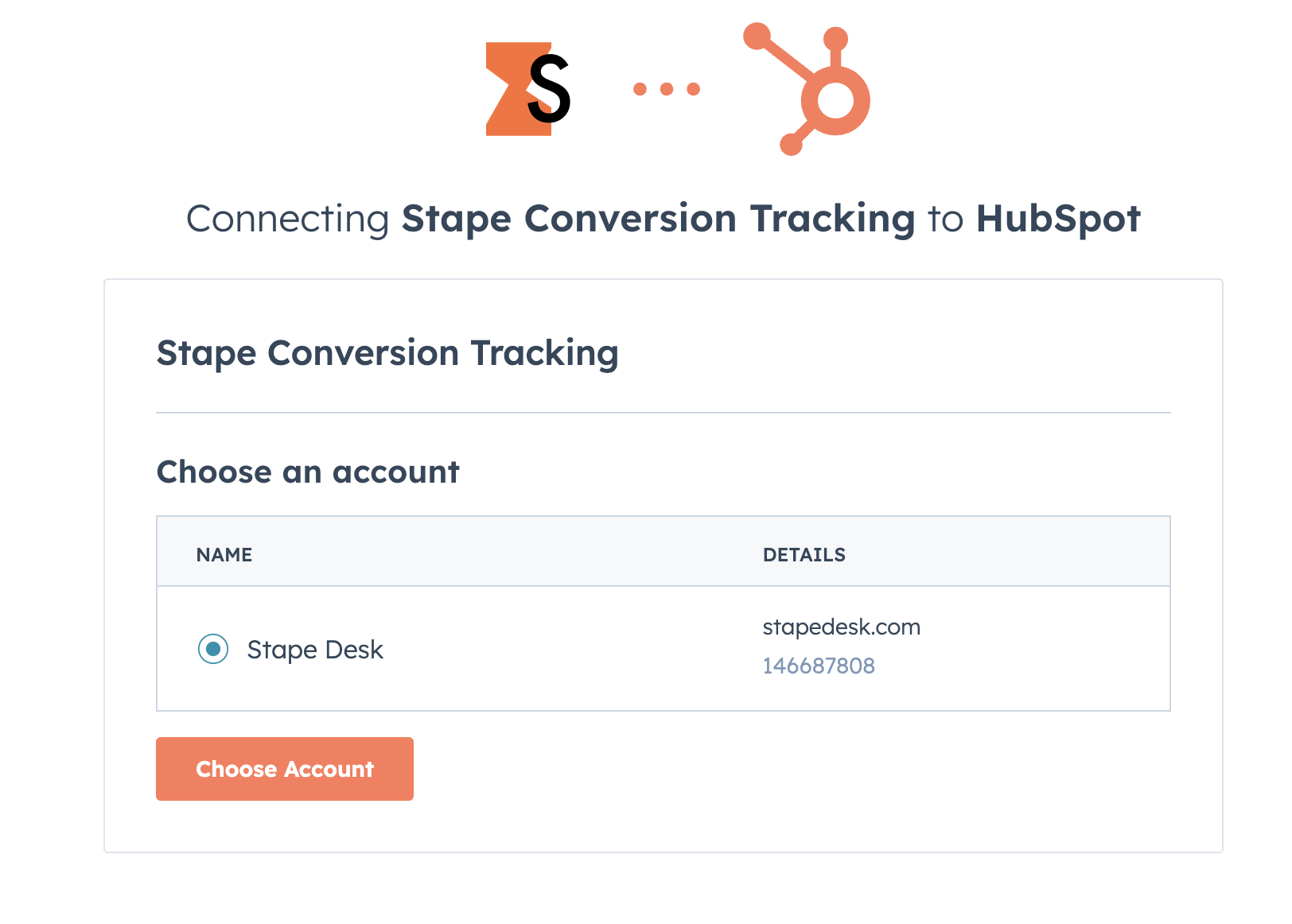
Connect app

1.3 Confirm access requested by the app and hit Connect app:
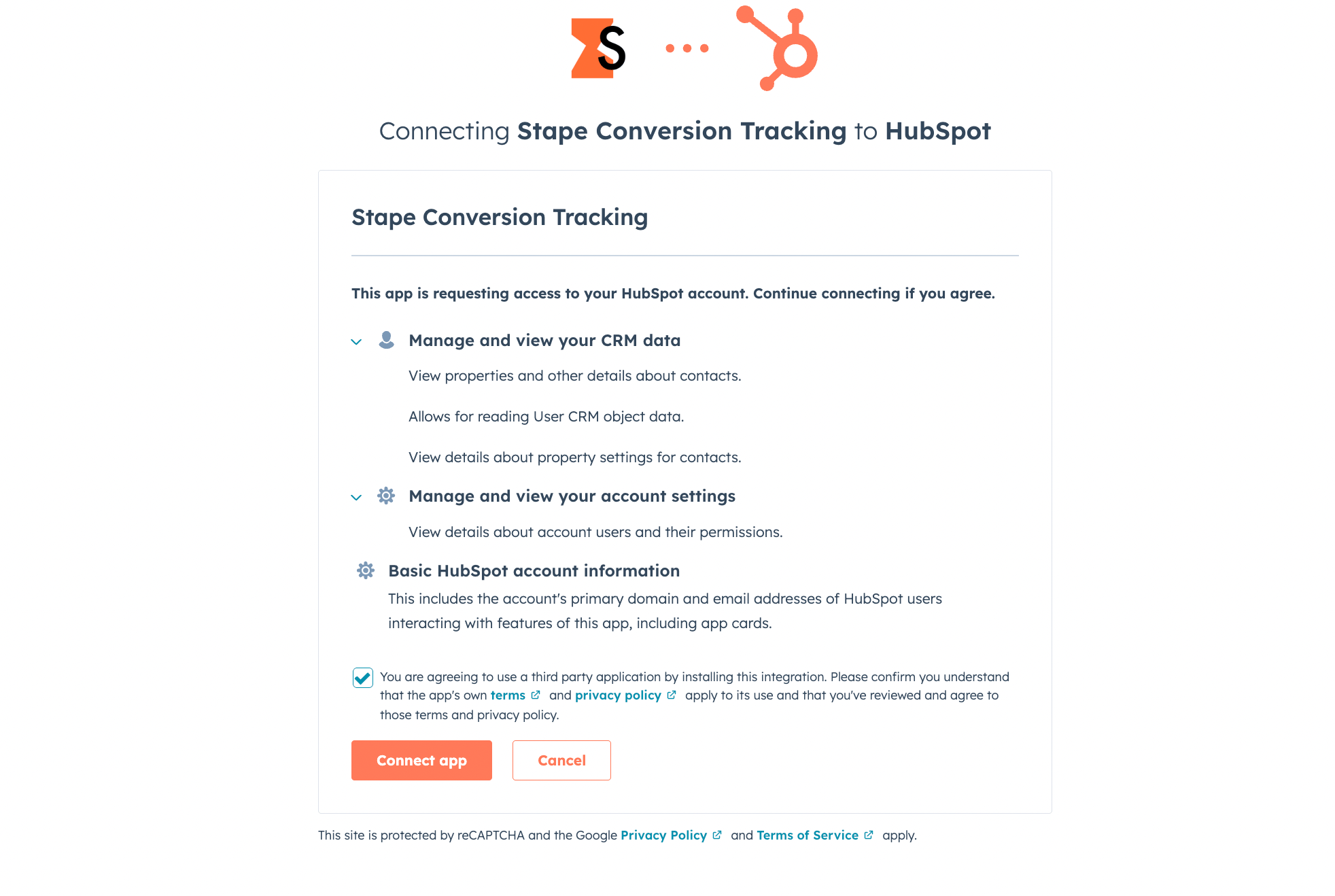
Connect app

You will see the following success screen:
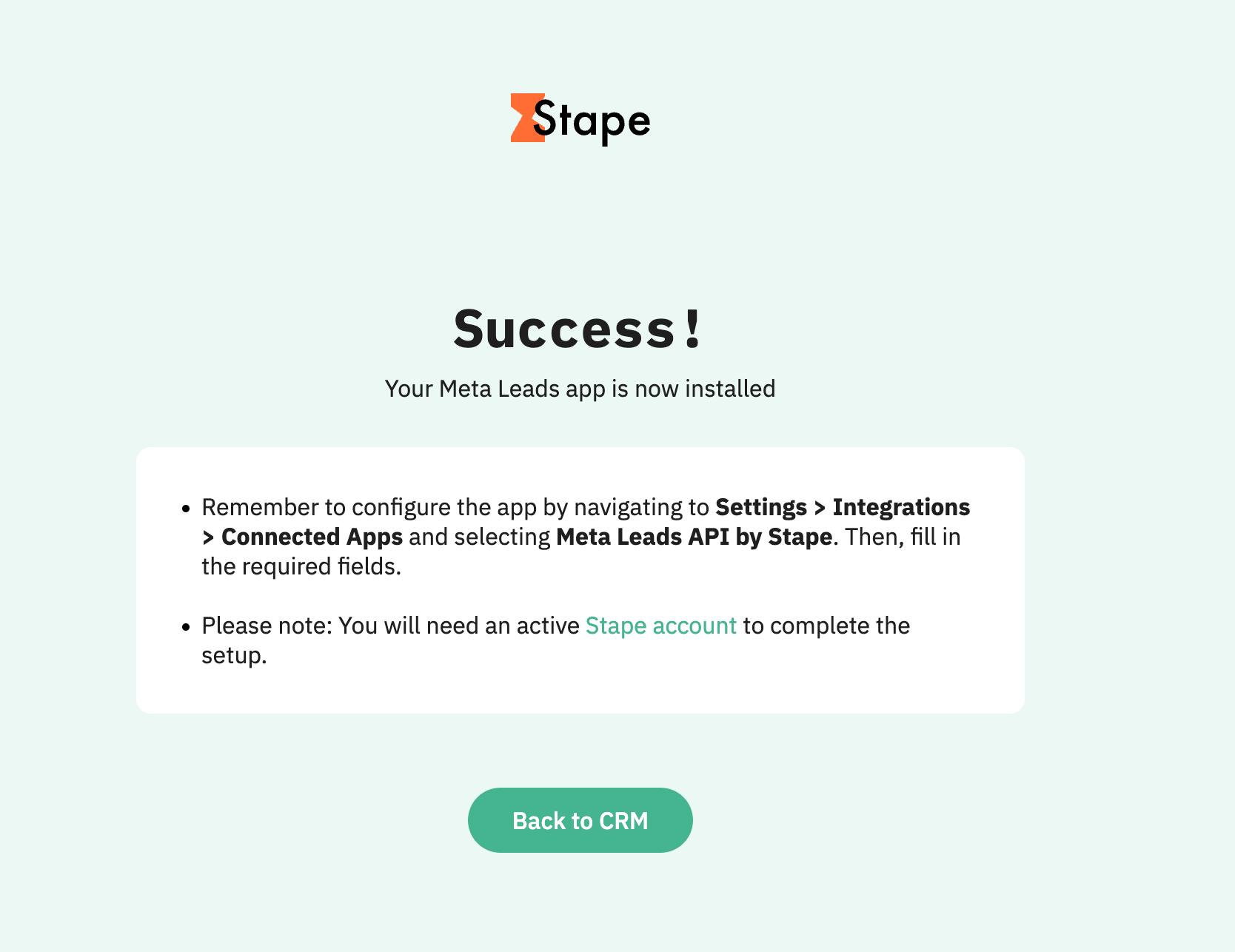
installed app

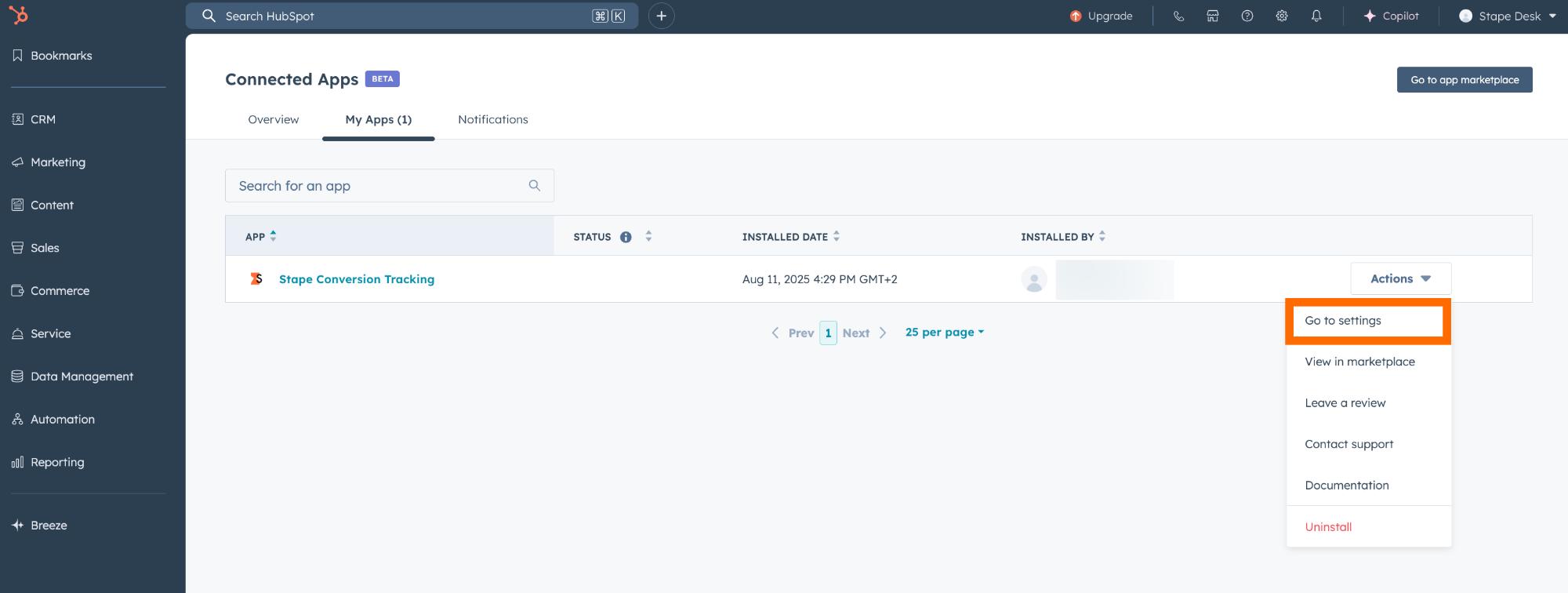
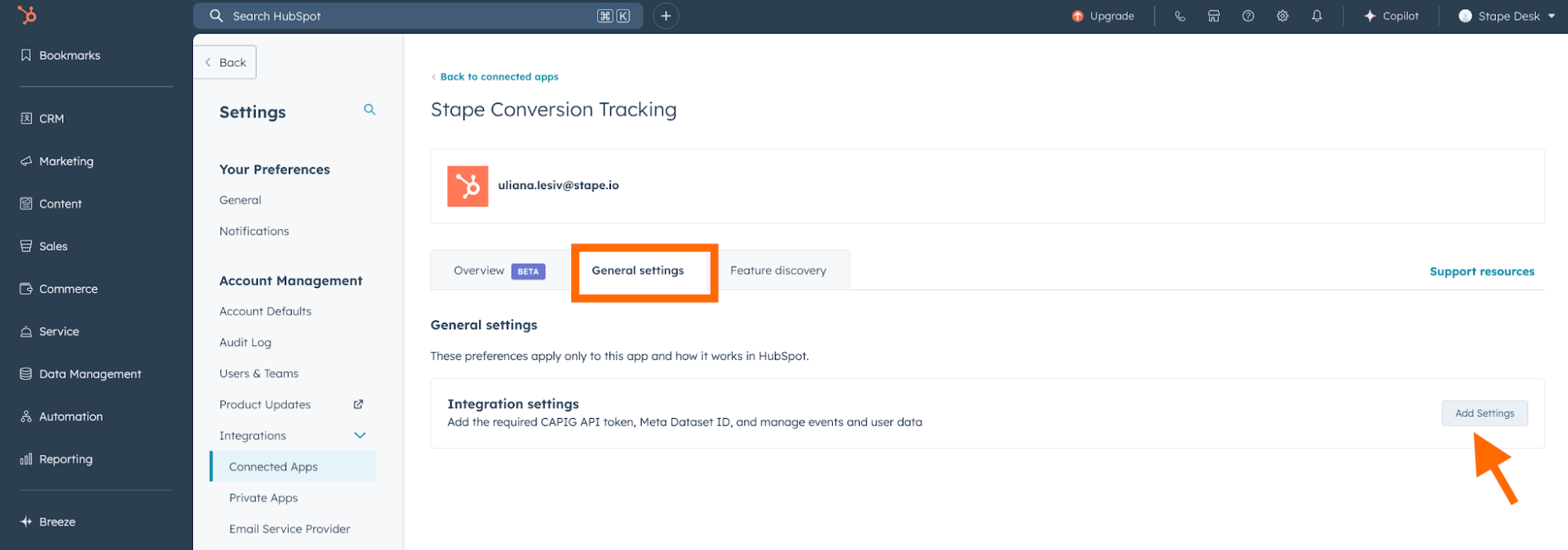
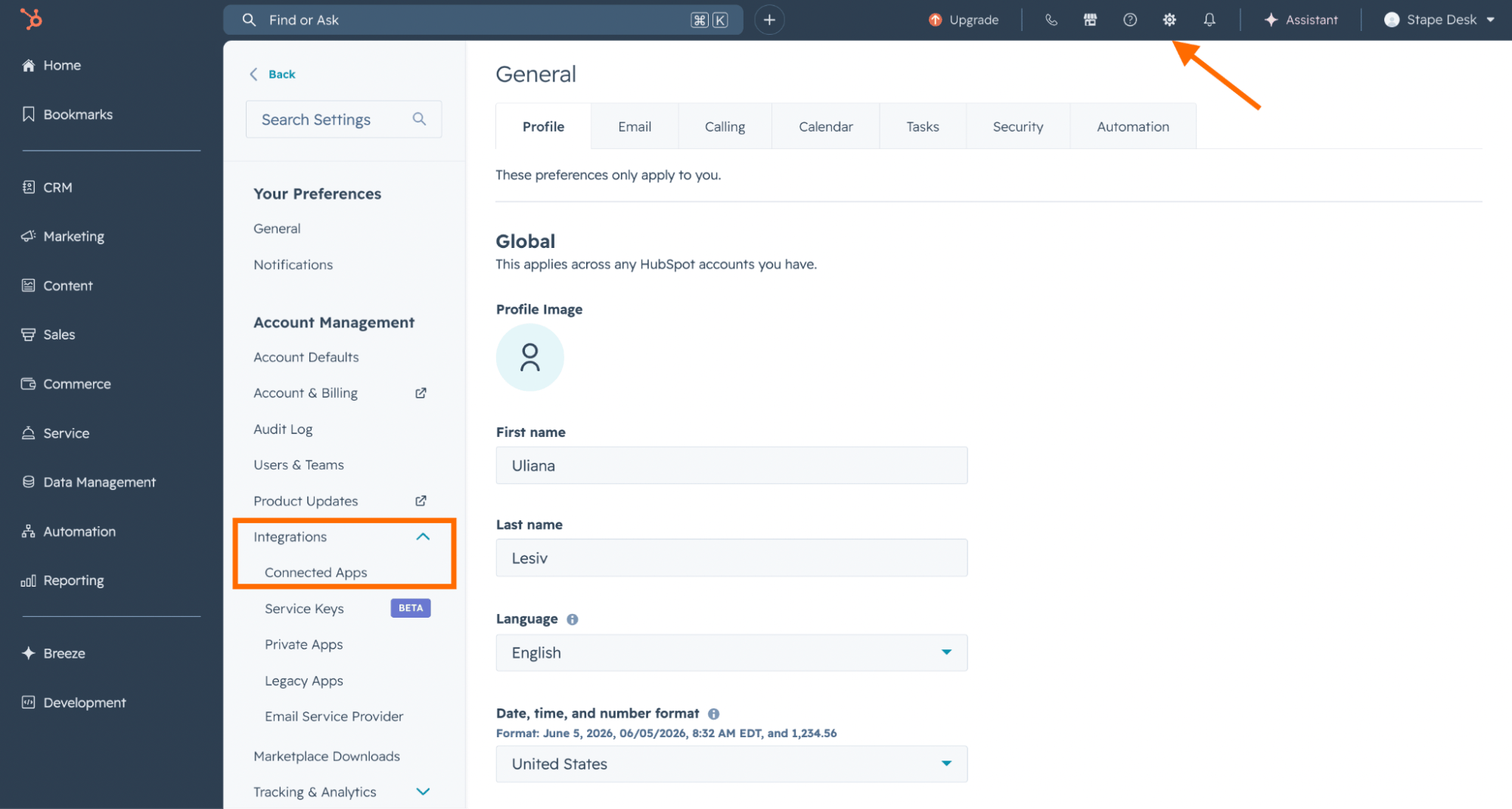
Go back to HubSpot CRM and pick an account you need. Then go to SettingsIntegrationsConnected Apps.

Connected Apps screen

On the next page click Add Settings:

Add settings

Integration methods: CAPI Gateway, Signals Gateway, server GTM or Customer Match

❗Please note before starting: Stape’s app supports multiple integrations simultaneously. Each integration method has its own tab with an “Activate integration” toggle; switch it on for the integrations you want to send data to.
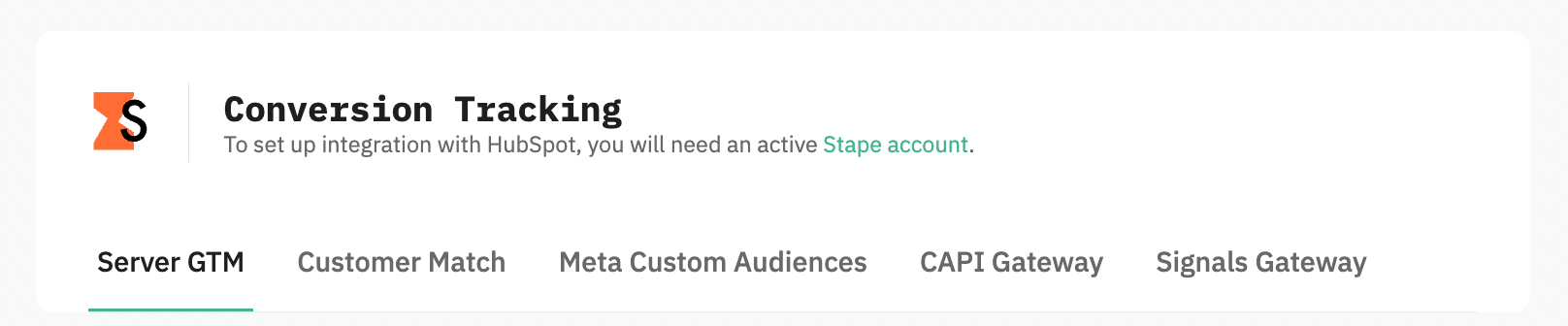
Integration methods

Integration method depends on your tracking setup and goals, and/or on your current experience with Stape. Click on the section below that corresponds to the tracking method you use:

Before you start

Make sure you have an active Stape account with Meta Conversions API Gateway

If you don't have an account on Stape, please create one or log in if you already have. In the main menu click More Gateways → Meta CAPIG → Create CAPIG on the top right.

Create Gateway button

Add name, email, and server location for new CAPIG. Then, choose the subscription plan and add billing details.

After creating Meta Conversions API Gateway in your Stape account, connect your Meta Dataset (Pixel) - just click Add data source → authorize in Meta → select the Business Manager and Dataset (Pixel) you want to connect.

Authorize in Meta

To increase the events match quality, please enable Automatic advanced matching.

Enable Automatic advanced matching

App setup

The setting process can be divided into two parts:

- Meta and Stape accounts data
- HubSpot CRM fields

Meta and Stape accounts data

You will need to fill in the following field:

meta dataset id

- Integration - switch Activate toggler on to enable the current integration (tab) to run in the background.

- Meta Dataset (Pixel) ID - a unique identifier that is used to configure integrations and view events in Events Manager. You can find it in your Meta account in Data Sources' Settings tab. See the detailed instruction on how to find Meta Dataset (Pixel) ID.

- CAPIG API Key - an alphanumeric string value that is needed for app identification. Find CAPIG API Key in the CAPIG settings section of your Stape account. See the detailed instructions on where to find CAPIG API Key.

Show CAPIG API Key

HubSpot CRM fields

Next you need to map your CRM fields to conversion event parameters.

- (Optional) Pick a field where Meta Lead ID is stored.

- Configure additional User data you'd like to send to Meta, by choosing a parameter in the left dropdown and selecting an appropriate field in the right-side one.

- Application sends conversion Events based on statuses of your Contacts, whenever a deal reaches a status you define, a corresponding event will be sent towards your Meta Dataset (Facebook Pixel). So we need to configure it by choosing one of two approaches:

  • In the left-side dropdown, select a Contact stage to trigger an event; in a box to the right, type the event name you'd like to send to Meta.
user data
  • Select the Send all statuses checkbox if you want to send all Contacts stages as events to Meta. Events are then named automatically and consist of a Contact status name. You can also select stages to ignore in this case.
events data

Once done, click Save and Connect. Once you see a success message your installation is complete and the application will send conversion events in the background based on your settings.

success

Before you start

Make sure you have an active Stape account with Signals Gateway

If you don't have an account on Stape, please create one or log in if you already have. In the main menu click Signals Gateway → Create Signals Gateway on the top right.

Create Signals Gateway on Stape

Add name, email, and server location for new Signals Gateway. Then, choose the subscription plan.

Status "Running" in the Signals Gateway
For more detailed instructions, check Stape's article on how to configure Signals Gateway.

App setup

The setting process can be divided into two parts:

- Signals and Stape accounts data
- HubSpot CRM fields 

Signals and Stape accounts data

You will need to fill in the following fields:

signals gateway pixel

Integration - turn on the Activate toggle to allow the current integration (tab) to run in the background.

- Signals Gateway Pixel - a unique identifier that is used to configure integrations and view events in Signals Gateway. You can find it in your Signals Gateway account in the Data Sources tab. See the detailed instruction on how to find Signals Gateway Pixel ID.

- Signals Gateway API Key - an alphanumeric string value that is needed for app identification. Find Signals Gateway API Key in the Gateway settings section of your Stape account. See the detailed instructions on where to find Signals Gateway API Key.

Show Signals Gateway API Key

HubSpot CRM fields

Next you need to map your CRM fields to conversion event parameters.

- (Optional) Pick a field where Meta Lead ID is stored.

- Configure additional User data you'd like to send to Signals Gateway, by choosing a parameter in the left dropdown and selecting an appropriate field in the right-side one.

user data

- Application sends conversion Events based on statuses of your Contacts, whenever a deal reaches a status you define, a corresponding event will be sent towards your Signals Gateway Pixel. So we need to configure it by choosing one of two approaches:

  • In the left-side dropdown, select a Contact stage to trigger an event; in a box to the right, type the event name you’d like to send to Signals Gateway pipeline.
events data
  • Select the Send all statuses checkbox if you want to send all Contacts stages as events to Signals Gateway pipeline. Events are then named automatically and consist of a Contact status name. You can also select stages to ignore in this case.
events data

Once done, click Save and Connect. Once you see a success message your setup is complete and the application will send conversion events in the background based on your settings.

success

Before you start

Make sure you have an active Stape account with a server GTM container hosted on Stape.

If you don't have an account on Stape, please create one or log in if you already have. In the main menu click sGTM → Create container on the top right.

Create an sGTM container

Add your container name, Container Configuration that you copied from your Google Tag Manager Server Container, and select server location. Click Create Container.  

App setup

The setting process can be divided into two parts:

- Stape accounts data
- HubSpot CRM fields

Stape account data

You will need to fill in the following field:

container api key

- Integration - turn on the Activate toggle to allow the current integration (tab) to run in the background.

- Container API Key - an alphanumeric string value that is needed for app identification. Find Container API Key in the Container settings section of your Stape account. See the detailed instructions on where to find Container API Key.

Container API Key in the Container settings section

HubSpot CRM fields

Next you need to map your CRM fields to conversion event parameters.

- (Optional) Pick a field where Meta Lead ID is stored.

- Configure additional User data you'd like to send to server GTM, by choosing a parameter in the left dropdown and selecting an appropriate field in the right-side one.

user data

- Application sends conversion Events based on statuses of your Contacts, whenever a deal reaches a status you define, a corresponding event will be sent towards your server GTM container. So we need to configure it by choosing one of two approaches:

  • In the left-side dropdown, select a Contact stage to trigger an event; in a box to the right, type the event name you'd like to send to server GTM.
events
  • Select the Send all statuses checkbox if you want to send all Contacts stages as events to server GTM. Events are then named automatically and consist of a Contact status name. You can also select stages to ignore in this case.
lead statuses

Once done, click Save and Connect. Once you see a success message your installation is complete and the application will send conversion events in the background based on your settings.

success

Configure sending data to the required platforms

With the current setup, the app will send events to your server GTM container, but to distribute them to platforms like Meta, TikTok, Google Ads, or any other, you need to configure the CAPI tags inside GTM to fire accordingly.

1. Configure the Data Client to claim the JSON requests sent from the CRM app. Go to the Templates → click “New” → upload the Data Client template you’ve previously downloaded from the Github.

2. Go to the Clients section of your sGTM container → click “New” → select Data Client. That’s basically it, your configuration will look like in the screenshot below. Click “Save”.

Data Client config

2. Select the platforms you need to send data to from sGTM. While setting up server-side tracking with sGTM, you might have already configured the CAPI tags for the required platforms, for example:

Or any other tags for platforms that support server-side tracking. You will need to use them to configure sending data from your CRM to the required platforms.

To give you an understanding of how to configure the tags this way, we will take the Facebook platform as an example. You should map the events according to the requirements of the platforms you use.

4. Create a new Facebook CAPI tag. Go to the Tags section in sGTM → add “Facebook Conversion API” as tag type.

5. Configure the tag.

Event Name Setup Method: Override

  • Event Type: Custom. Select a built-in variable “Event name”.
  • Action Source: System Generated.
  • Add Pixel ID and generate API Access Token: for the detailed instructions on how to find these values, please refer to our guide on where to find Meta Pixel ID and API Token.

Here is an example of how your configuration will look at this point:

Facebook CAPI tag basic config
  • User data section: select properties from the drop-down list - Lead ID, Browser ID, Click ID. These three are basic.

For each property, add a variable that will take the appropriate value from the request sent from the CRM app.

Create a following variable for Lead ID:

- Variable Type: Event Data

Key Path: lead_id

Lead_id variable

Create two different variables for Browser ID and Click ID:

- Variable Type: Event Data (for both), as the IDs will be retrieved from the event sent from CRM, not from the cookie.

- Cookie Name: fbp (for Browser ID variable) and fbc (for Click ID variable)

Fbc variable
FBP variable

Here is an example of the user data section configuration:

Example of the user data section configuration
  • Custom data section: add a few custom fields to identify the source of the event.

Event_source property name with crm value.

lead_event_source - as property value, add a variable with the following configurations:

- Variable Type: Event Data

- Key Path: lead_event_source

Lead_event_source variable

Here is how this configuration will look like in the tag:

Custom Data section configuration

6. Add a trigger for a tag.

Use the following configurations:

- Trigger type: Custom

- This trigger fires on: Some events

Besides, add the following conditions for a tag to trigger:

- Client Name equals Data Client

- Action Source equals system_generated

The variable for action source must have configurations as on the screenshot below:

Action source variable

- Event Source equals crm

Configure the variable for the event source as shown in the screenshot:

Event source variable

As a result, your trigger will look similar to the example from the screenshot below:

Trigger configuration example

7. Test the setup.

Since it is, in fact, a webhook that is sent from CRM to the server GTM, you can refer to the article on debugging incoming webhooks in server GTM for the detailed instructions.

If you are using Customer Match as a configuration method for the Stape Conversion Tracking HubSpot app, once configured, a new Customer List will be created in Google Ads. Please note, only Customer Lists created automatically by the Stape connection are supported.

Manually created or pre-existing lists in Google Ads will not be populated. For more info on Customer List, please check our article.

Before you start

Make sure you have an active Stape account with a server GTM container hosted on Stape.

If you don't have an account on Stape, please create one or log in if you already have one. In the main menu, click sGTM → Create container on the top right.

Create container on Stape

Add your container name, Container Configuration that you copied from your Google Tag Manager Server Container, and select the server location. Click Create Container.

For more detailed instructions, check Stape's article on how to set up a Google Tag Manager server container.

App setup

The setting process can be divided into two parts:

- Stape and Google Ads accounts data

- HubSpot CRM fields

Stape and Google Ads account data

You will need to fill in the following fields:

container api key

Integration - switch Activate toggler on to enable the current integration (tab) to run in the background.

- Container API Key - a string used for app identification. Find Container API Key in the Container settings section of your Stape account. See the detailed instructions on where to find Container API Key.

Find the Container API Key
  • Google Ads Operating customer ID - the ID of the Google Ads account where the Customer List will be created or updated. To get it, sign in to your Google Ads account → in the top right corner, click on your picture → copy the value.

Please make sure to remove hyphens before using the string as the Operating customer ID.

Google Ads Operating customer ID
  • Google Ads customer ID - stands for the ID of the account that you're using for authorization. Based on the type of account, you should copy the following values.

- If you're using your customer account, use the customer account ID.

- If you access the customer account through a manager account, use the manager account ID.

Please make sure to remove hyphens before using the string as the customer ID.

Where to find the customer account ID and the manager account ID

HubSpot CRM fields

Next, you need to map your CRM fields to audience member identifiers.

  • User data - choose the data you want to fill the Customer List in Google Ads with, and specify user and ads data consent status from the drop-down list. 

Please note: Address data will be included only if all four fields (First Name, Last Name, Region, Postal Code) have values.

  • Actions & triggers - choose Action, Opportunity Status, and name a Customer List to be synced to. After configuring Customer Match in the HubSpot app, a Customer List will be created in Google Ads.

Please note: stape_ is always appended, and the name of the list must always start with "stape_," e.g., stape_hubspot_purchasers.

  • Backfill - if you check this box, the app will sync existing contacts using the settings in the app above. When the unchecked box is selected, it will sync only new contacts that reach the configured statuses. Unchecking later doesn’t remove contacts already synced.

Once done, click Save and Connect. Once you see a success message, your installation is complete, and the application will send conversion events in the background based on your settings.

success

Settings editing

If you have some changes in the funnel or you want to change the events sent to your CAPI Gateway, server GTM container, or Signals Gateway, you can always edit your app configuration.

To do this, go to SettingsIntegrationsConnected Apps and follow the steps from section 1 of this manual.

Conclusion

Using the Stape Conversion Tracking HubSpot CRM app is a convenient and easy way to configure sending data on Contacts' statuses from HubSpot to Meta, Google Ads or other platform. To start using the app, you need to have the Stape account and configure one of the server-side tracking methods - server GTM, Meta Conversios API Gateway, or Signals Gateway.

Want to start on the server side?Register now!

author

Uliana Lesiv

Author

Uliana is a Content Manager at Stape, specializing in analytics and integration setups. She breaks down complex tracking concepts into clear insights, helping businesses optimize data collection.

Comments

Try Stape for all things server-side