How to maximize data quantity and quality with Stape & Piano in a privacy-first setup
Written by
Nicolas Hinternesch
Data privacy, compliance, and security are at the core of most organizations’ data strategy - especially in heavily regulated industries and regions. While failing to comply bears hard risks like fines and penalties, it also comes with considerable soft risks, such as reputational damage. On the flip side, maintaining a privacy-centric data stack also brings challenges with regards to the value and the level of competitive advantage that can be gained from successful analysis and activation of data.
Getting a grasp of these challenges and their impact on data quantity and quality can be difficult for organizations, as they span a wide range of domains of expertise: technical implementation and data collection, server-side processing and storage logic, data modeling as well as analysis and reporting.
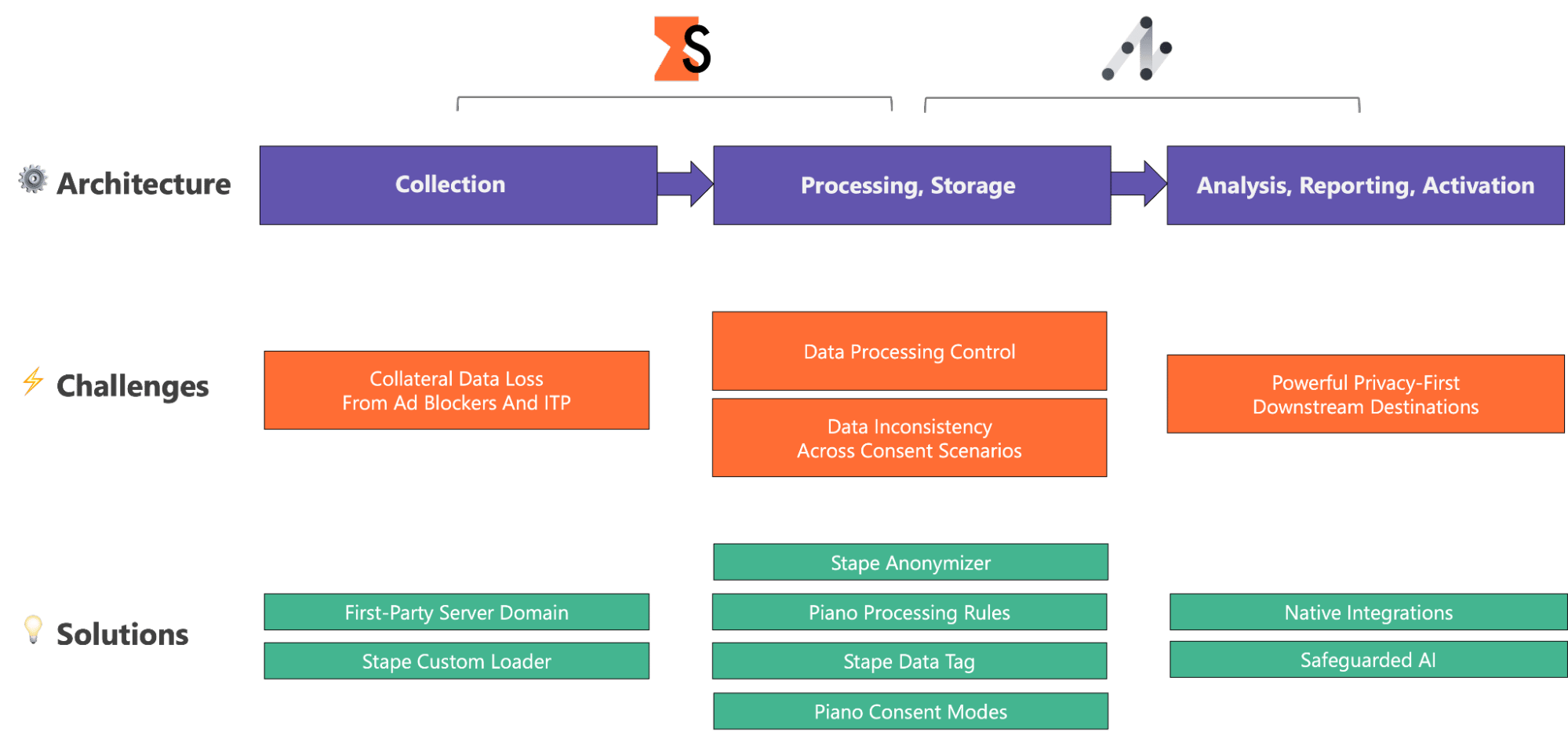
In this guide, I will break down four challenges across these domains and introduce practical solutions you can apply right now with the unique combination of Stape and Piano.
Challenge 1. Collateral data loss from ad blockers and ITP
Challenge
Ad blockers and ITP regulations are the most widely adopted client-side methods that let users control and protect their browsing experience. Often however, they lack nuance, as they paint with a broad brush and do not differentiate between different martech endpoints and their varying purposes. Collecting protected data for the purpose of regulated audience measurement in line with privacy standards is a different practice than collecting and sharing personal data across parties for advertizing or data brokering.
In scenarios, where users theoretically consent with the former but want to avoid the latter, pure play analytics SDKs are often collateral damage of ITP and ad blockers, as they fend off third-party domain SDK loading and known data collection endpoints altogether without allowing any nuance based on the visitor’s consent choices.
Solution
- Use a custom domain and DNS record configuration for your Stape server
- Use Stape Custom Loader to enable server-side SDK hosting
Configuring your data collection architecture in a first-party context allows you to prevent unintentional data loss in the first technical instance and collect raw data including consent choices and signals for certain regional processing requirements. If you have the full picture, you can consequently apply the right processing rules to each data point - depending on the consent scenario and the individual data destination and usage purpose.
Challenge 2. Data processing control
Challenge
A lot of analytics- and martech-platforms in the role of data processors act as a black box as soon as data hits their collection servers. This leaves the data controllers with little to no control over how data is processed. Not only does this expose organizations to significant risk, which can even be multiplied across various data processors with varying privacy conceptions - it also undermines their ability to centrally take the right steps to balance privacy requirements with maximizing data quality depending on the individual data destination.
Solution
- Use Stape Anonymizer
- Use Piano Processing Rules and Stream Inspector
Both Stape and Piano give you full transparency and control over the incoming raw data and the processing to be applied to each data point. First, the server-side tagging environment provides a central layer of governance in your own secure first party context to control distribution across data destinations. Here is where Stape offers privacy-focused power-ups like Anonymizer that help you control, remove, or anonymize personal data.
When data is forwarded to Piano, Piano’s Stream Inspector and Processing Rules let you monitor, validate, and modify the incoming data to ensure it is clean and compliant for storage and analysis. This level of processing autonomy across Stape and Piano allows you to fully respect user rights, consent choices, and privacy guidelines - while perfectly balancing privacy requirements with maximizing data quality for each individual data point.
Challenge 3. Data inconsistency across consent scenarios
Challenge
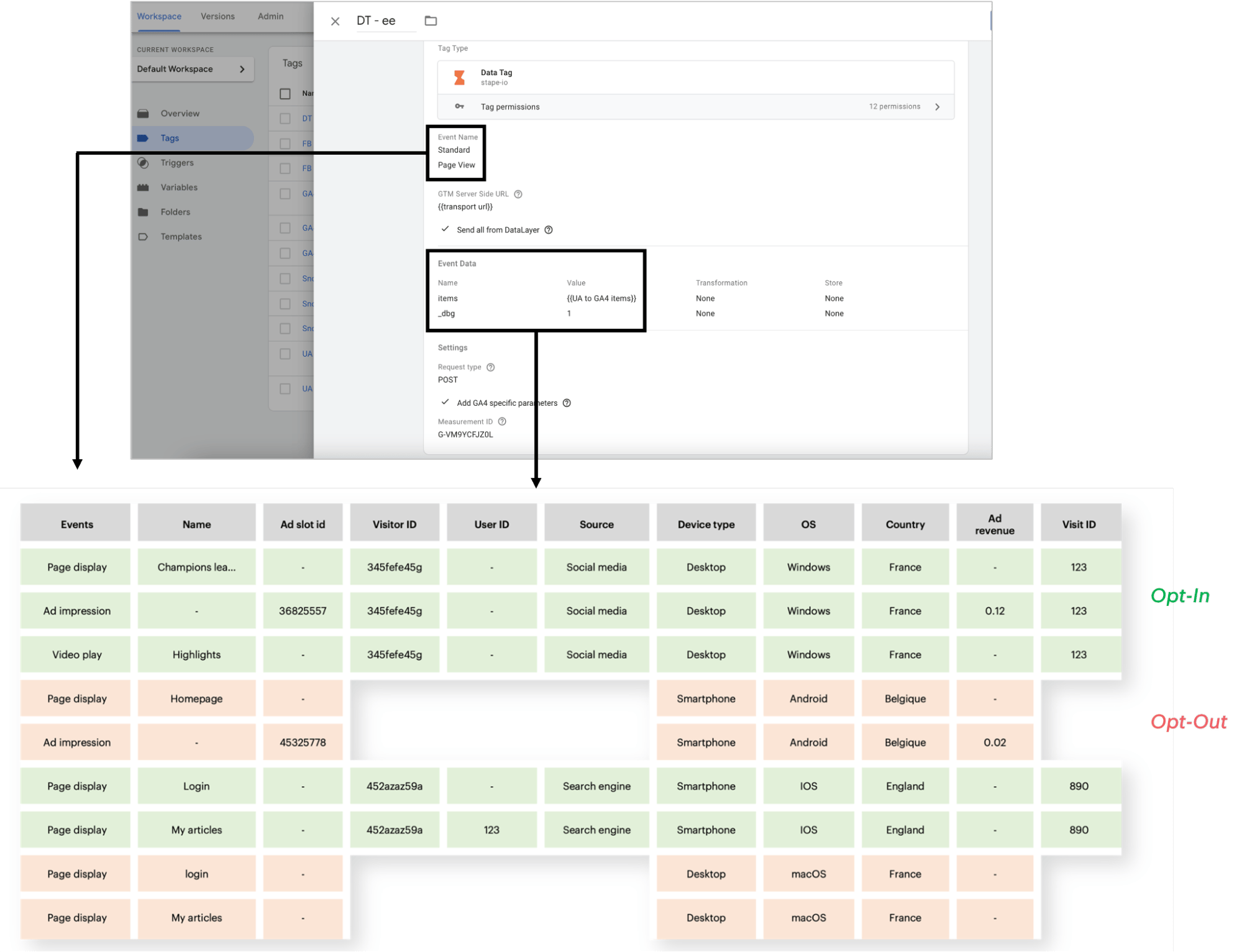
Each behavioral data point across your product is happening in a distinct consent scenario. This has massive implications on the data that is - and is not - available for each event. For instance, some events will only carry contextual parameters with no session- or user-level identification whatsoever. Some events will have full session-, user-, and identified customer identification.
Some events will carry source information in the payload, in the request headers, or in URL parameters, while others will not. Some events will have to be modified, stripped, or excluded from certain metric calculations or analysis types altogether. The challenge here lies within collecting, governing, and modeling the inconsistent data in a unified structure and making it available in a single platform for coherent and meaningful analysis.
Solution
- Configure Piano Consent Modes and Consent Exemption
Stape Data Tag collects a wide range of parameters, including the full data layer, in a consistent event-centric data structure. The event-based model serves a foundational structure to populate outgoing tags from the server-side TMS.
As part of the event data, the user consent preferences can be passed to Piano, which inherently triggers the respective processing and storage of said event data. Consent modes are used to configure data treatment in a privacy-compliant way, while extracting the most value possible from each event:
1. Opt-in: Full consent, all data, session-, user-, and customer-identifiers.
2. Exempt: Consent-less, selected data, session-, and user-identifiers.
* This configuration is based on an expressly issued ePrivacy exemption for compliant audience measurement and relies on a specific configuration.
3. Extended Opt-out: Consent-less and cookie-less, all event data.
4. Opt-out: An alternative to extended opt-out. All events will be completely anonymized and excluded from regular analysis. Only a simple event counter and the reason for the exclusion will remain.
The event-centric data model inherited from a Stape Data Tag implementation maps perfectly to Piano’s holistic data model architecture, which serves as the baseline for real-time, unsampled, and unified reporting and analysis. The organizational data is kept in a single flat table to combine 100% of the behavioral data in a single view and therefore ensure maximum consistency between events originating from varying consent scenarios.
Challenge 4. Powerful privacy-first downstream destinations
Challenge
Having established Stape as a privacy-first foundation of the data collection stack, the successive challenge is ensuring the same standard across a variety of downstream data processors across analytics and activation. Dealing with evolving regional compliance guidelines requires reliable and proactive technology partners across the stack. The additional compliance challenges from securely integrating AI innovation for a competitive advantage are layered on top and can throttle AI adoption.
Solution
- Use the native Stape and Piano integration to combine two privacy-first platforms
Stape and Piano are natively integrated through modern server-side GTM templates and consistent data structures. This allows you to build your end-to-end analytics stack around privacy-first platforms, who don’t treat data security as reactive requirements, but instead as a fundamental aspect of the culture - proactively maintaining the right tools, infrastructure, resources, and people to meet all relevant regulations and guidelines. Both Stape and Piano hold a variety of international certifications, including but not limited to GDPR, HIPAA, ISO/IEC 27001:2022, CCPA, and EuroPrivacy, making the combination one of the most compliance-ready analytics setup available globally. Especially in heavily regulated industries, this can be a real competitive advantage.
As soon as data is flowing from Stape through the native Piano connector, you can benefit from out of the box AI innovation with no manual configuration or development - without exposing data or users to inherent AI-related security risks. Piano AI features are embedded across the entire platform and include contextual insights and recommendations, anomaly detection, natural language querying, MCP integration, propensity scoring, lookalike modeling, content profiling, knowledge management and many more.
Bottom line
The rapidly evolving nature of the technology- and privacy-landscapes makes it crucial to deliberately design an organizational tech stack around privacy-first components. This allows businesses to address the multifaceted privacy-related challenges across the data lifecycle with powerful tools, features, and solutions.
It is often assumed that opting for privacy and compliance means compromising on powerful, state of the art, advanced downstream functionality. While the former are considered “Hygiene Factors” - the expected foundation -, the latter are considered “Performance Factors” - driving business outcomes and competitive advantage. However, these are not mutually exclusive. Data quantity and quality can be maximized in a privacy-first setup.
Want to join the server side?
Try for freeRecommended for you
Oct 2, 2026
Blog
Piano Analytics server-side tracking configuration guide
Recover lost data and improve site performance by moving Piano Analytics to server-side GTM. Learn how to configure the Stape Piano Analytics Client and Tag.
May 8, 2026

Comments