Sep 8, 2026
From blind spots to 38% attribution recovery: a healthcare tracking overhaul | Stape Care
Written by
Alina Zatyshna
Published May 14, 2026 comments
Key takeaways
- A healthcare client's existing server-side tracking setup left 41.09% of Google Analytics 4 (GA4) sessions unassigned and only 2 events tracked.
- The Stape Care team rebuilt the setup by adding Consent Mode integration, replacing DOM-based triggers with a Data Layer, and implementing Custom Loader and Cookie Keeper power-ups.
- After the overhaul, unassigned sessions dropped from 41.09% to 3.3%, engaged sessions grew by 244.9%, and tracked key events increased by 195.7%.
A healthcare client approached the Stape Care team requesting an audit and optimization of their existing server-side tracking setup. The previous implementation failed to provide reliable data for business decision-making due to critical attribution issues and an incomplete picture of user behavior.
Problem: "blind spots" and 41% attribution loss
Despite already having an sGTM container in place, the client’s analytics remained largely unusable due to several technical shortcomings:
- Attribution crisis: 41.09% of all sessions in GA4 were categorized as Unassigned, making it impossible to accurately evaluate the performance of advertising channels and SEO efforts.
- Limited user journey tracking: only two events were being tracked - page_view and an appointment booking event - which prevented the client from analyzing the full user journey.
- Unreliable triggers: the primary key event relied on an Element Visibility trigger, resulting in duplicate conversions on page refreshes and unstable firing behavior whenever the site layout changed.
- Missing Consent Mode: although the website displayed a consent banner, tracking tags were not integrated with it. For a healthcare client, this meant both compliance risks and damaged attribution quality in GA4.
Solution: rebuilding the tracking setup with Stape
The team performed a full restructuring of the tracking mechanism and implemented best practices for server-side tracking.
- Expanded event tracking: the number of tracked events increased from 2 to 11, allowing the client to capture the complete user journey across the website.
- Data Layer implementation: instead of relying on DOM scraping, the setup was rebuilt around a structured Data Layer. This ensured stable and reliable tracking regardless of visual or frontend changes to the website.
- Consent Mode integration: tracking tags were synchronized with user consent preferences. This enabled GA4 behavioral modeling to fill data gaps and restored proper attribution continuity between sessions and traffic sources.
- Protection against Ad Blockers & ITP Restrictions: Custom Loader and Cookie Keeper power-ups were implemented to make the tracking setup more resilient against ad blockers and browser ITP restrictions. This approach extends cookie lifetime and improves attribution accuracy by preserving first-party tracking signals more effectively across user sessions.
Results: transparent data and marketing confidence
A comparison between February-May 2026 and the same period in 2024 demonstrated a dramatic improvement in analytics quality.
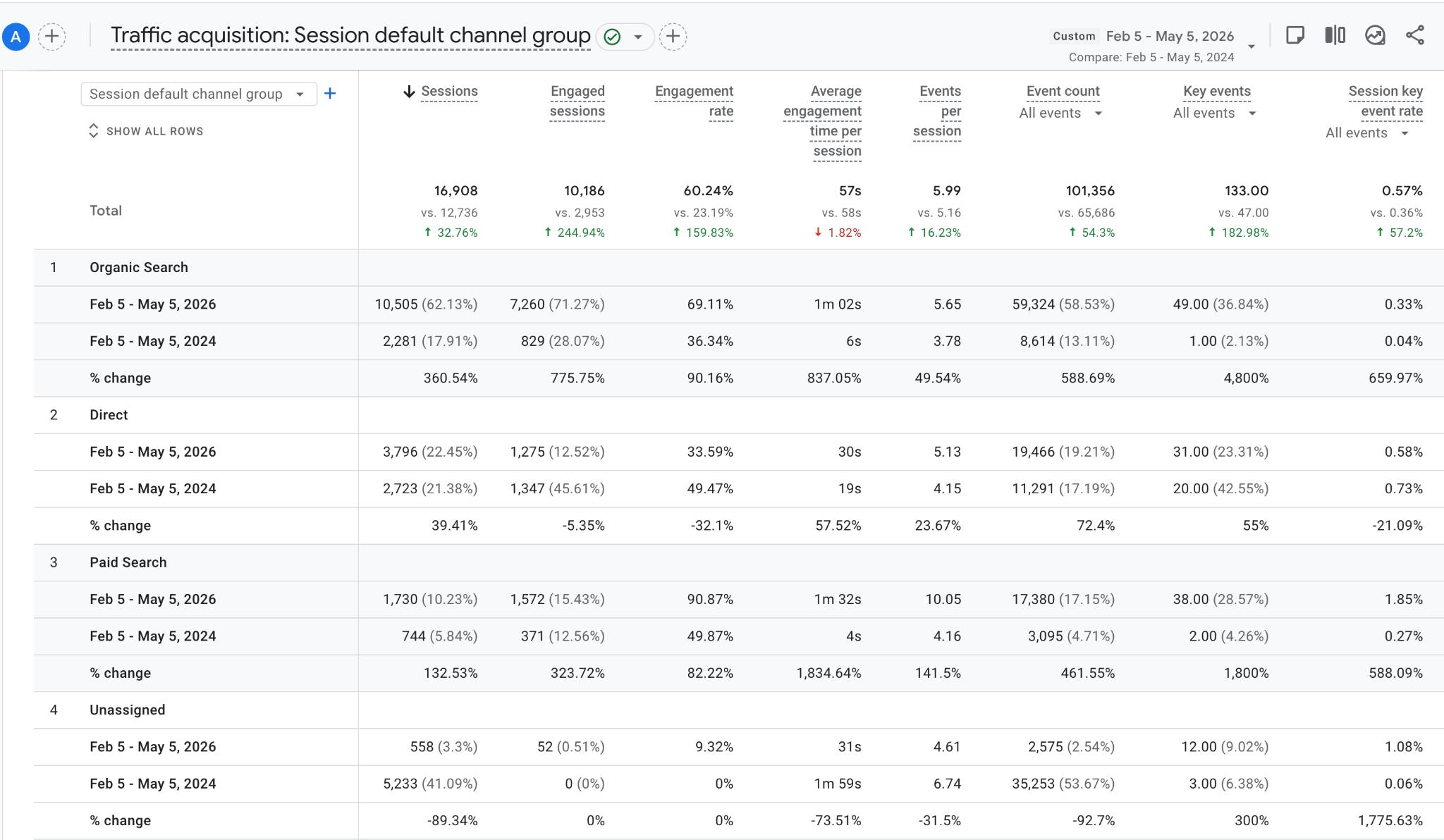
1. Attribution recovery (Traffic Acquisition): the most significant improvement was the near elimination of unknown traffic sources:
- Unassigned sessions dropped from 41.09% to 3.3%.
- Organic Search increased from 17.9% to 61.1% as traffic sources began being identified correctly.
- Paid Search attribution accuracy improved from 5.8% to 10.2%.
2. Engagement quality: with stable server-side tracking and extended cookie lifetimes, engagement metrics became far more reliable:
- Engaged Sessions increased by 244.9% (from 2,953 to 10,186).
- Engagement Rate improved from 23.19% to 60.24%.
- Average Engagement Time increased significantly, indicating that previously fragmented “short sessions” were successfully resolved.
3. Conversion performance: instead of relying on questionable visibility-based triggers, the client gained accurate reporting for meaningful business actions.
- Tracked Key Events increased by 195.7%.
- This provided the marketing team with the trustworthy data needed to confidently scale advertising campaigns.
By implementing server-side tracking with Stape, the client transformed fragmented and unreliable analytics into a stable data infrastructure built for accurate attribution and long-term scalability.
Why сhoose Stape
By setting up server-side tracking with Stape, you can:
- Restore more accurate attribution by reducing unassigned traffic in analytics.
- Protect tracking against ad blockers and Safari ITP restrictions using Custom Loader and Cookie Keeper power-ups.
- Extend cookie lifetime and maintain attribution continuity across user sessions.
- Synchronize tracking with Consent Mode to stay compliant while improving GA4 behavioral modeling.
- Improve engagement metrics and conversion visibility through more stable tracking setups.
- Provide marketing teams with more reliable data to scale campaigns and make confident decisions.
Want to start on the server side?
Try for freeWas this article helpful?
Recommended for you
Aug 6, 2025
Blog
Data discrepancies explained: causes, how to identify and fix
Most data mismatches aren’t bugs - they’re limitations. Learn how to identify discrepancies, uncover missing data causes, and take control of your tracking.
Sep 2, 2026

Comments