Purchase event data loss fixed with server-side tracking | Peak Metrics

Matteo Boscolo
AuthorKey takeaways
Background
The client operates in the publishing eCommerce and natural wellness sector, with a broad catalog of physical and digital products and a strong dependence on paid media for acquisition and retention.
Their primary objective was to improve the quality of marketing measurement: more reliable tracking, more consistent attribution across platforms, and data robust enough to optimize advertising campaigns. In particular, it was essential to rebuild a credible view of conversions after years of increasing data fragmentation caused by the limits of browser-side tracking.
To address this, the client partnered with Peak Metrics, a digital analytics agency and official Stape partner.
Challenge: systematic undercounting of Purchase events
Before the server-side implementation, the client showed a clear discrepancy between real transactions recorded by the eCommerce platform and Purchase events detected in analytics platforms.
The issue was driven by several structural factors:
- Ad blockers and privacy-first browsers limiting client-side tag firing.
- Intelligent Tracking Prevention (ITP) and cookie restrictions.
- Signal loss during the checkout process.
- Increasingly unreliable attribution windows.
- Difficulty using conversion data for automated bidding strategies.
From a statistical standpoint, the dataset showed a systematic undercounting bias: observed Purchase events were consistently lower than actual transactions, reducing the quality of information available to advertising algorithms.
Solution: switching to server-side infrastructure hosted on Stape
Peak Metrics chose a server-side infrastructure based on server-side Google Tag Manager, hosted through Stape, for three main reasons:
- Fast implementation and simplified operational management.
- Stable and scalable infrastructure for significant eCommerce volumes.
- Greater tracking resilience against browser-side limitations.
Stape allowed Peak Metrics to reduce technical deployment time and focus more on data quality, event deduplication, and setup validation.
Results: near-perfect alignment between GA4 and real transactions
The implementation process was straightforward: initial audit, server-side container setup, routing of core events (Page View, Add to Cart, Begin Checkout, Purchase), QA, and comparative validation against order management data. The most relevant result concerned Purchase tracking.
Before server-side:
- Purchase events significantly diverged from real transactions.
- Low trustworthiness of observed conversion data.
After implementation:
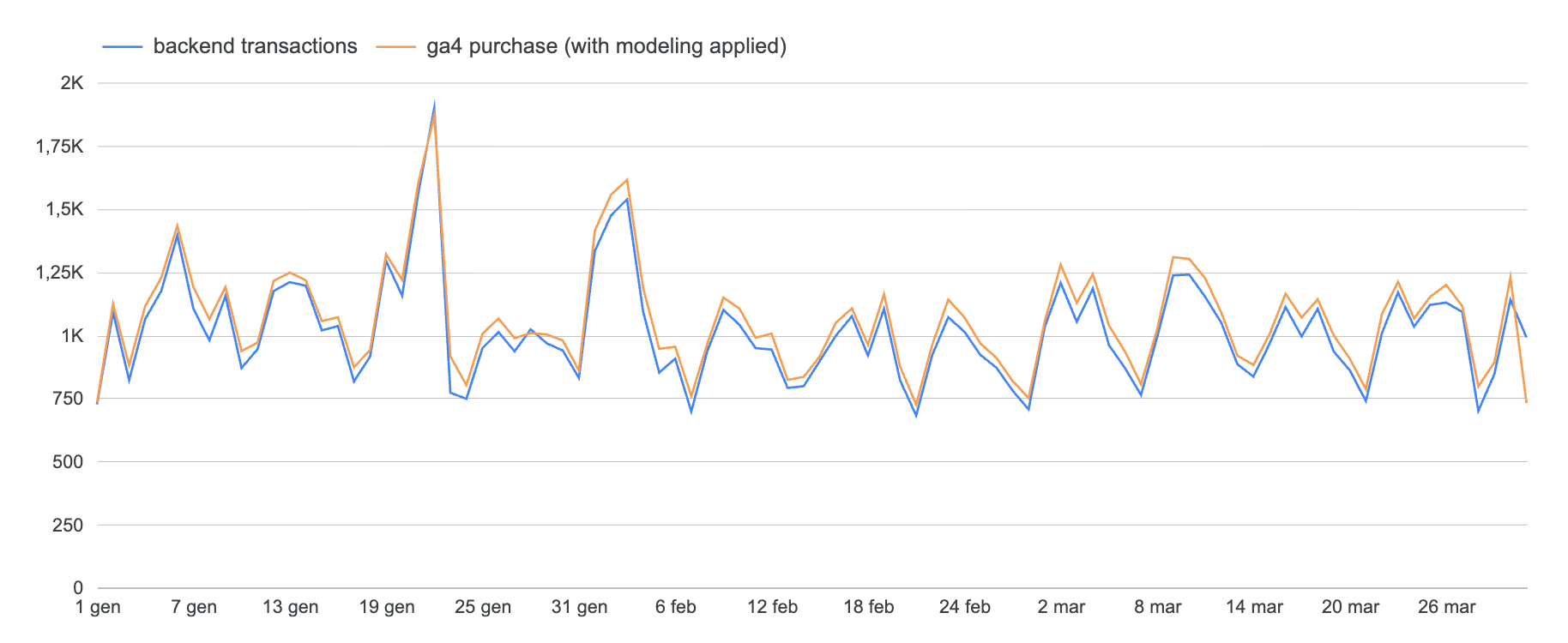
- The gap between actual transactions and modeled Purchase events in Google Analytics 4 progressively closed.
- Thanks also to GA4 conversion modeling, the two signals became highly correlated.
- Today, the data shows near-perfect alignment, with consistent temporal behavior and no structural discrepancies.
In statistical terms, the setup moved from a condition of high systematic error to one of strong agreement between time series, with correlation approaching unity and a substantial reduction in residual variance between real sales and measured conversions.
This materially improved:
- Reporting reliability.
- Quality of signals sent to advertising platforms.
- Campaign optimization based on business-representative outcomes.
Impact on the agency business
For Peak Metrics, the benefits were twofold.
- More credible reporting. When analytics data converges with real revenue data, the client conversation changes completely: less time spent discussing discrepancies, more time focused on strategic decisions.
- Stronger media performance. Algorithms fed with more complete conversion signals tend to make better decisions in bidding and audience allocation. The result was increased client trust and a more mature working relationship built on quantitative evidence rather than fragile estimates.
Takeaway: reliable data as the foundation for better marketing decisions
Server-side tracking enabled Peak Metrics to close the gap between actual transactions and reported conversions, providing the client with a reliable data foundation for campaign optimization and strategic decision-making.
Recommendations from Peak Metrics:
- Always validate analytics data against real business transactions
- Continuously monitor event deduplication
- Maintain consistent naming conventions and taxonomy
- Use server-side tracking as the foundation for future enhancements (CAPI, enhanced conversions, first-party data strategies)
Next steps for Peak Metrics include further refinement of the data ecosystem and advanced integration testing to improve attribution quality and advertising performance even more.
| "We would recommend a server-side setup to any company investing seriously in digital advertising and needing reliable data. The point is not to track more, but to measure better." |
| - Peak Metrics. |
Why choose Stape
- Fast deployment: reduced technical implementation time, allowing focus on data quality and validation rather than infrastructure setup.
- Scalable infrastructure: handles significant eCommerce transaction volumes without reliability trade-offs.
- Browser-side resilience: bypasses ITP, ad blockers, and cookie restrictions that cause systematic undercounting on client-side setups.
- A foundation for what's next: server-side tracking as the base for future CAPI, enhanced conversions, and first-party data strategies.

Comments