Jul 2, 2026
25–35% tracking accuracy improvement for OMRON Healthcare EMEA | Hellenic Technologies
Written by
Patrick Abedin
Published Jun 24, 2026 comments
Key takeaways
- OMRON Healthcare EMEA needed to close measurement gaps across multiple European markets caused by browser restrictions, ad blockers, cookie limitations, iOS tracking prevention, and inconsistent regional requirements, all while maintaining compliance and preserving the quality of marketing insights.
- Hellenic Technologies replaced OMRON’s centralized GTM setup with dedicated country-level containers, which facilitated cleaner governance, market-specific tracking, and stronger regional compliance.
- Server-side GA4 tagging, combined with enhanced conversion tracking, improved data collection reliability and reduced data loss from modern privacy and browser restrictions.
- A GDPR-compliant consent framework powered by iubenda introduced Consent Mode v2, prior consent blocking, multi-language experiences, geo-specific configurations, and consent record management across localized websites.
- The implementation improved data completeness by 25–35%, increased event capture and improved attribution accuracy by 20–30%, boosted conversion tracking reliability by 15–25%, while delivering deeper insights into customer intent, regional demand, and online-to-offline purchase behavior.
Challenge: measurement gaps across markets and complex regional privacy restrictions
Privacy-first marketing is no longer optional. For enterprise brands operating across multiple countries, the real challenge is not just collecting data. It is collecting the right data, in a compliant way, across different markets, languages, platforms, user journeys, and legal requirements.
This was the challenge for OMRON Healthcare EMEA. OMRON operates a large ecosystem of localized websites across Europe, helping users discover healthcare products such as blood pressure monitors, ECG devices, pain relief products, digital scales, and thermometers.
But like many multinational brands, their analytics setup needed to evolve. A centralized Google Tag Manager structure, browser restrictions, cookie limitations, ad blockers, iOS tracking prevention, and inconsistent regional requirements were creating gaps in measurement and limiting the quality of marketing insights.
Less reliable attribution. Incomplete user journey visibility. More complexity across markets. And a growing need for a stronger privacy-first data infrastructure.
Solution: integrating localized tracking, server-side analytics, and consent governance into a unified framework
At Hellenic Technologies, we worked with OMRON Healthcare EMEA to design and implement a modern digital measurement and compliance framework built around three pillars:
1. Multi-market tracking architecture
We moved from a centralized GTM setup to dedicated country-level Google Tag Manager containers, allowing each market to have cleaner, more relevant, and more compliant tracking configurations.
This created stronger control over regional tagging, reduced conflicts, improved governance, and made it easier to deploy market-specific events and pixels.
2. Server-side tracking and higher-quality data
We implemented GA4 server-side tagging to improve the reliability of event collection and reduce data loss caused by browser restrictions, ad blockers, cookie limitations, and iOS privacy policies through Stape.
We also supported enhanced conversion tracking through server-side integrations, including Meta Conversions API on selected websites and improved Google Ads conversion tracking.
The focus was not to track more for the sake of tracking more. The focus was to track better.
High-value events were prioritized, including:
- Product views
- Form starts and form submissions
- Marketplace outbound clicks
- Store locator interactions
- Support interactions
- Engagement and session quality signals
This gave OMRON clearer visibility into what users were doing, which products they were interested in, and how online behavior connected with marketplace and offline retail intent.
3. GDPR-compliant consent management with iubenda
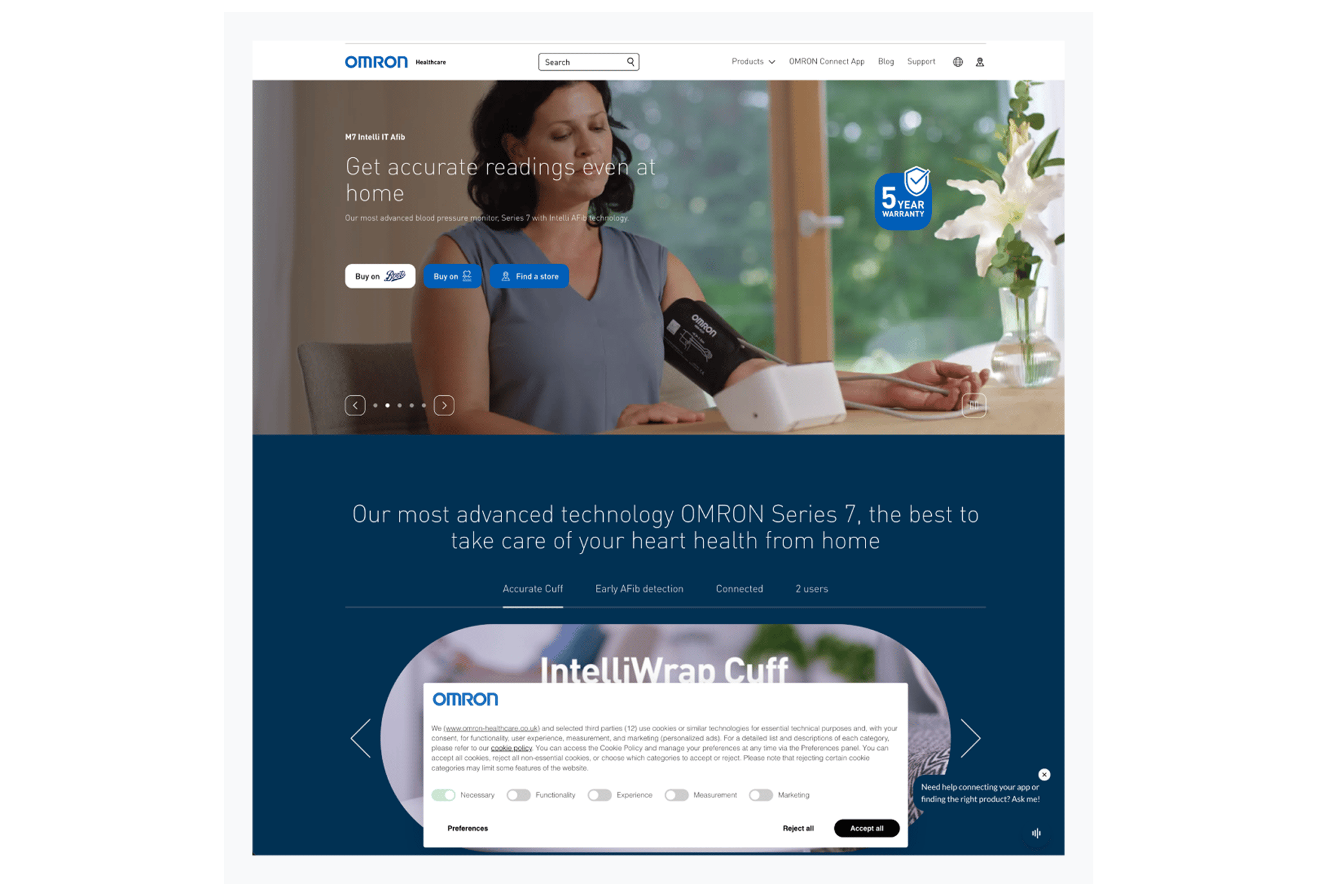
A critical part of the project was the implementation of iubenda's Consent Management Platform across OMRON's localized websites, delivered by Hellenic Technologies as a certified iubenda Gold Partner.
This included cookie consent banners, prior consent blocking, Google Consent Mode v2, IAB Transparency and Consent Framework support, multi-language experiences, geo-specific configurations, and consent record management.
The objective was simple:
Respect user privacy while preserving the quality of business-critical analytics.
Results: up to 35% improvement in data completeness and richer cross-market business intelligence
The impact was significant:
- Tracking data completeness and accuracy improved by approximately 25–35%
- User event capture improved by approximately 20–30%
- Conversion tracking reliability improved by approximately 15–25%
- Marketing attribution precision improved by approximately 20–30%
- Consent opt-in rates exceeded 50%
- OMRON gained a more scalable and privacy-first analytics framework across its EMEA digital ecosystem
Beyond the technical implementation, the project unlocked deeper business intelligence. OMRON gained better visibility into regional product demand, customer intent, marketplace referrals, store locator usage, and the moments when users were most likely to move from online research to offline purchase consideration.
For a healthcare brand operating across multiple countries, this kind of insight is extremely valuable. It supports better media planning. Better product prioritization. Better regional decision-making. Better compliance governance. And ultimately, better customer experiences.
The bottom line
This project reflects the direction in which enterprise digital analytics is moving. The future is not just about more data. It is about cleaner data, consent-based data, server-side infrastructure, and measurement systems that respect both business performance and user privacy.
At Hellenic Technologies, we help enterprise brands build privacy-first digital ecosystems that are compliant, scalable, and performance-ready across markets.
Why choose Stape
By setting up server-side tracking with Stape, you can:
- Reduce data loss caused by browser restrictions, ad blockers, cookie limitations, and iOS privacy policies.
- Improve GA4 event collection reliability and conversion tracking accuracy across channels, including Meta Conversions API and Google Ads.
- Gain clearer visibility into high-value user events and how online behavior connects with offline purchase intent.
- Maintain analytics performance in consent-driven environments with Google Consent Mode v2 support.
- Build a scalable server-side infrastructure that works across multiple markets and regional compliance requirements.
Want to start on the server side?
Try for freeWas this article helpful?
Recommended for you
Jul 2, 2026
Blog
Cookies, the GDPR, and the ePrivacy Directive
What cookies do and why they matter. How cookies are affected by the GDPR, CCPA, ePrivacy Directive and ePrivacy Regulation. Cookie compliance best practices.
Oct 5, 2026

Comments