Oct 6, 2026
TikTok Ads conversion tracking: cost and conversion rate insights
Written by
Tymofii Sankov
Updated Sep 30, 2026 comments
Key takeaways
- 1.TikTok conversions can be tracked using Pixel, TikTok Events API hosted via server GTM, or via Gateway. The last two options offer more reliable tracking results and better compliance.
- 2.TikTok and Instagram have different audiences and types of ads available. TikTok is more aimed at a young audience with good buying opportunities.
- 3.You should always measure post-view conversions on TikTok as this platform specializes in post-view impact, and customers may not click on your ads directly, but visit the website later.
TikTok is one of the biggest social media platforms, with 16.000 videos being uploaded every minute and almost ⅓ of the world's population registered users. Thus, it is not surprising that TikTok advertising is so popular, and TikTok ad campaigns may cost a small fortune (up to $200,000 per week for a premium segment).
Considering that, measuring the conversion rate for the commercials running on the platform becomes of vital importance. In this article, we will cover different methods for gathering data to measure campaign performance, answer the most popular questions on TikTok Ads, and give recommendations on how to improve your results.
What is TikTok advertising?
Advertising on TikTok is a complex process that consists of choosing one or several of the different ad formats, developing the strategy, communicating with influencers, launching campaigns, measuring their effectiveness and conversion rate, gathering the available data about customers, and adapting your approach based on the gathered information.
TikTok has become a powerful ad platform for eCommerce and digital marketing businesses where they can promote their products and services, reaching massive amounts of viewers daily. It offers various ad formats that suit companies of different sizes, budgets, and goals.
What is TikTok ads conversion tracking?
TikTok ads conversion tracking is crucial for getting performance data and measuring the effectiveness of your TikTok ads. It is a complicated process that consists of several stages:
- gathering the conversion data about the customer actions after they interact with the ads;
- sending the gathered data to TikTok for further analytics;
- adjusting the ad budget and content based on the analytics results received.
A good conversion rate for TikTok ads typically ranges from 1% to 3%. A common approach is to preserve and look for minor adjustments if the number you have is in that range. You should review your TikTok ads and start thinking about changing something if the number goes below 1%, and thoroughly review your bidding strategy, targeting approach, and ad quality if it drops to 0.5% or below.
Why does conversion tracking for TikTok ad campaigns matter?
Numerous reasons exist why the conversion rate of your TikTok should matter.
- 1.It allows you to measure the ROI of your commercials and understand whether they lead to the desired financial and customer-number outcomes or not.
- 2.You can optimize your campaigns cognitively when you know exactly how each of them performs and what results they demonstrate.
- 3.Conversion tracking helps you to identify your target audience better and focus on launching commercial campaigns to reach their specific needs.
- 4.It gives you better insight into user behavior and their path to conversion, which can become a firm base for marketing funnel modification.
- 5.You get clear and practical feedback on what creatives make effective TikTok ads and which ones perform poorly and need to be changed.
To sum up, TikTok conversion tracking shows you which ad campaigns are effective and what makes them such (e.g., intuitive funnel, quality creatives, etc.). Based on its results, you can make decisions based on the "field" data rather than your intuition, improve ROI, and even optimize your company's ad spend.
What is the TikTok Events API?
The TikTok Events API is a server-side solution for sending the TikTok ads conversion data from the server GTM container or Gateway to TikTok Ads Manager. This method is more reliable and precise than simply using the tracking Pixel on the client's side to communicate with analytics. The whole procedure looks as follows:
- when a user performs an action on your website, it is recorded by the Pixel and sent to the server;
- on the server, all the personal data is encrypted, and data gaps are filled if possible;
- Events API sends the data package to the analytical platform.
This method is more resistant to ad blockers and more compliant with privacy policies, which makes it a better choice for user data tracking, compared to the conventional usage of the Tracking Pixel on the client's side.
How to set up TikTok ads conversion tracking?

There are 3 basic methods for setting up TikTok conversion tracking, some of which guarantee a more consistent performance than others.
TikTok Pixel tracking
The TikTok Tracking Pixel is a piece of JavaScript code to be added to your website's header section either manually or using a Google Tag Manager container. Setting it up is the standard starting point for TikTok Pixel tracking.
- 1.Log into your TikTok Ads Manager account, switch to the Events section, and create a new TikTok Pixel.
- 2.Copy your new Pixel's code and paste it either in the header of the website or in any tag manager, for instance, Google Tag Manager container.
- 3.Configure the event you want to track by adding the event codes where necessary.
- 4.Launch TikTok Pixel Helper (an extension for Chrome) to test whether the newly installed Pixel fires correctly.
To streamline the setup and get the most out of TikTok Pixel, you may also consider using the TikTok Pixel tag developed by Stape. It simplifies the installation of Pixel, supports standard and custom TikTok events, can perform automatic Data Layer mapping for GA4 and eCommerce events, and much more.
The Pixel is good for TikTok ads tracking as it is easy to configure, cheap, does not require any additional settings or resources, and tracks all the website actions directly.
Talking about its disadvantages, it relies on the client-side tracking technology and thus, can be vulnerable to ad blockers and browser restrictions. Moreover, it does not provide control over the tracked data before it is sent to analytics. This means there is a risk of compliance issues – a limitation worth keeping in mind for TikTok Pixel conversion tracking specifically, since blocked or incomplete requests translate directly into missed conversions.
TikTok Events API through server GTM
The TikTok Events API is a solution for server-side tracking; it acts as a bridge between the server and the analytical platform. Talking about server-side, it is a more reliable approach to data tracking. It supposes that the Pixel sends all the tracked data to the cloud server, where it can be checked for compliance, enriched with the missing data, and then sent to TikTok Ads Manager. The last step is when you need the TikTok Events API.
- 1.Create a server Google Tag Manager container via the official service from Google and host it with Stape.
- 2.Set up the Data Tag and use it as a transfer mechanism to send the tracked data from the web to your server container. Use EventID to configure deduplication, as Pixel simultaneously sends web events.
- 3.In the server GTM container, add the TikTok Events API tag from the Template Gallery, set it up, and add the events you want to track (check a more detailed guide on how to configure the TikTok Event API).
- 4.Test your setup by reviewing whether you get the required data in your TikTok Ads Manager.
The Events API provides you with complete control over the tracked data and has rich customization capabilities in terms of the events that can be sent to analytics. However, you need to pay for that with a more profound server-side tracking expertise and the requirement to set up almost everything manually.
TikTok Events API Gateway
The TikTok Events API Gateway is another way to set up TikTok server-side tracking for conversion events. It helps reduce data loss caused by ad blockers and browser restrictions.
To start using it, you need to register for the Events API access first. Then, however, you won't add it to the server GTM but rather deploy it via the Gateway.
- 1.Create the TikTok Events API Gateway with us by logging into your Stape account and proceeding to the "Gateway" tab in the TikTok section.
- 2.When done, log in to your TikTok Events API Gateway account and connect the needed Pixels there via the Connect Data Source tab.
- 3.Test your setup to ensure that everything launches and transfers the data as it should by checking the data displayed in your TikTok Ads Manager.
Hosting an API via a Gateway is a cheaper and easier-to-configure approach, which provides you with fewer customization possibilities, though. We have a detailed guide on TikTok server-side tracking via GTM and Gateway. Do not hesitate to check it if you need more details on the steps and nuances.
TikTok Pixel vs server-side tracking
The Pixel and server-side tracking (Events API, whether through server GTM or the Gateway) aren't mutually exclusive – but they answer different needs.
TikTok Pixel is faster to set up, free beyond hosting your own tags, and requires no server infrastructure. It's a reasonable starting point for smaller sites or early-stage testing, but it inherits every limitation of client-side tracking: ad blockers, browser restrictions like ITP, and no ability to inspect or clean data before it's sent.
Server-side tracking (Events API) removes that dependency on the browser. Events pass through a server first, where they can be checked for compliance, enriched with missing data, and hashed before reaching TikTok. This makes it more resistant to data loss and better suited for accounts running any meaningful ad spend, at the cost of more setup work – either configuring a server GTM container yourself, or using the Gateway for a simpler but less customizable path.
In practice, most accounts get the best results running both together: Pixel for real-time client-side events, Events API for server-side coverage, tied together with deduplication so the same conversion isn't counted twice.
What is better, TikTok Pixel or TikTok Events API?
The TikTok Events API is better because it transfers the package of tracked data from the server, when it is compliant and with all possible gaps filled. This allows for getting the analytical reports of higher quality. The Tracking Pixel, on the other hand, operates in real-time and runs between the client's browser and analytics. This means there is no chance for encrypting or removing all the privacy data, and everything blocked by the ad blockers or browser restrictions is completely ignored and never reaches its destination. Thus, if you are not sure what to choose, TikTok Pixel or Events API, it is a good idea to stick to the latter.
Examples of TikTok Ads
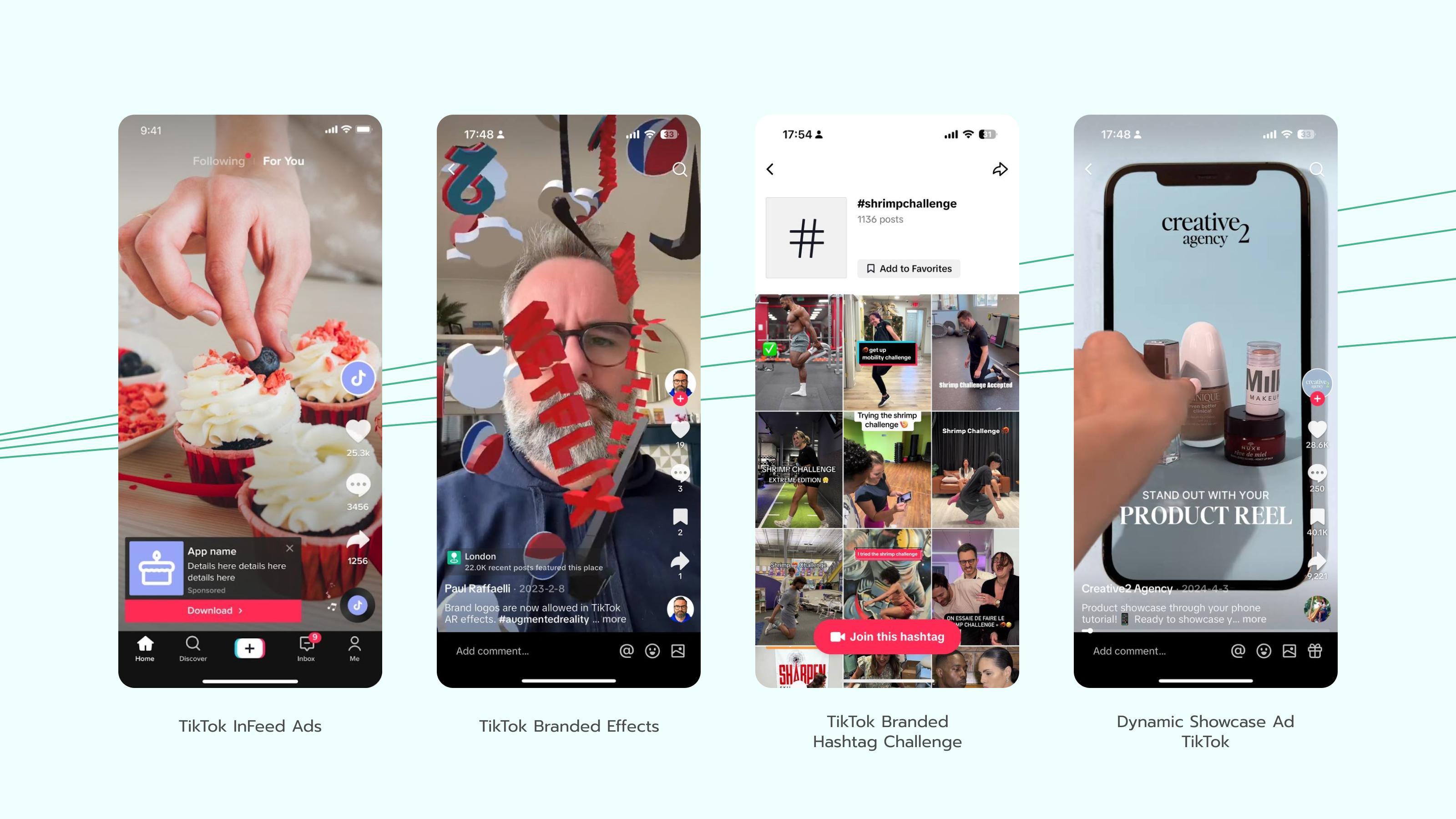
Different types of ads are available to businesses that decide to launch commercials on TikTok. Depending on whether you are aiming at lead generation, user interaction, or increasing brand awareness, choose the ad group that best meets your needs.
- 1.In-Feed ads. These are short videos that can pop up in the user's feed at a random moment. A common practice for this type of ad is to make these videos short and skippable. Brands often stick to it to boost visibility and raise user interest in their product or service.
- 2.TopView ads. It is another type of video ad format that launches when a user opens the TikTok app. It is 5 seconds long, non-skippable, and generally follows the same goal as the In-Feed Ads. It is more effective, though, for brand exposure, due to being the first thing people see when they open TikTok.
- 3.Branded hashtag challenges. This is one of the most effective methods of user engagement. Brands create specific hashtags and encourage people to share content related to them. This increases the amount of user-generated content and can boost sales drastically if one of these TikTok videos goes viral.
- 4.Branded effects. TikTok users can add AR filters and effects to their videos, allowing brands to communicate with their audience in a trendy and artistic way.
- 5.Collection ads. This type of TikTok lets users scroll through the presented products and choose what they need without leaving the app. It is also known as carousel ads.
- 6.Dynamic Showcase ads. High-performing ads aimed directly at each particular user and based on the dynamic creative optimization technology.
The cost for different types of TikTok ads may vary, so always decide which to use based on your campaign objectives and business goals.
What are the benefits of launching a TikTok campaign?
TikTok is an extremely popular platform among teenagers and young adults. People under 34 are the most numerous user group - almost 70%. Basically, this means that the majority of potential customers are people familiar with the internet, with jobs, money, and familiar with modern trends. Consequently, it makes sense to expect more sales on TikTok than on any other resource with a less solvent audience.
One more important point is the variety of ad content available on the platform. From simple short-form videos to hashtag challenges, from AR effects to well-known carousels, TikTok ads work because they are creative, original, and novel.
What is the TikTok conversion rate by industry?

Below, you can find the average TikTok conversion rate for different industries. However, if you get a similar number, it does not mean that there is nothing else to be done. You can and should always work on increasing CVR and adjusting your ads depending on your campaign goals.
| Industry | Average CVR |
|---|---|
| Retail & eCommerce | 0.46% |
| Beauty & skincare | 0.6% |
| Food & beverage | 0.7% |
| Technology & gadgets | 0.5% |
| Financial services | 0.3% |
It is worth mentioning that the financial services industry is the hardest to convert, as there are more trust barriers due to its specifics. You can consider increasing your minimum daily budget to get better results, but this will also influence your CPR, so you need to be careful when making such decisions and always consider all pros, cons, and key metrics you are aiming at when setting expectations for TikTok ads conversion rate.
TikTok ad content vs. Instagram: main differences
Although both platforms may seem similar at first glance, the TikTok community is very different from Instagram's. Both services may also have different formats available and ad placement rules. Check the table below to get a general idea of the main differences.
| TikTok | ||
|---|---|---|
| Ad Formats | Video commercials (spark ads, in-feed videos, top view, etc.), carousels, AR effects. | Video commercials, carousels, stories, reels, image ads. |
| Style | Raw, creator-style, native looking, natural. | More polished, edited, professional-looking. |
| Algorithms | Interest-first, good for engaging with new audiences. | Works better for communities, followers, and retargeting. |
| Conversion behavior | Fast engagement, but it is more demanding to landing pages for users to convert. | Has a stronger purchase intent due to an integrated shopping service. |
| Cost | CPM and CPC are usually lower. | More competitive and expensive. |
| Best for | Promoting new brands, fast growth, viral attention. | Interest targeting and retargeting, conversions, long-term brand building. |
These differences, however, do not mean that you should never try to launch a new brand advertisement on Instagram or try to launch successful campaigns based on interests on TikTok. Social media algorithms can often work in an unexpected and unexplainable way. Thus, in this sphere, everything is worth trying.
Additionally, while TikTok offers a low entry barrier for video creators, it is also worth evaluating Spotify advertising cost for a well-rounded strategy, as it allows you to reach the same young audience during screenless moments.
How much does it cost to run ads on TikTok?

TikTok advertising costs may vary significantly. The average CPM for TikTok ads ranges from $3.20 to $10. Acceptable CPC is on the level of $0.2 - $0.5. This number depends on various factors:
- ad format: in-feed ads are cheaper than TopView ads or branded effects;
- audience targeting options: the narrower the targeting, the more competitive the audience, the higher the cost;
- location: costs vary depending on the region where you want to launch your campaign.
- creativity: TikTok algorithms reward natural and creative content with lower effective costs;
- campaign objective: if you want your TikTok campaign to convert, it usually costs more than the one aimed at increasing brand awareness (impressions).
Thus, if you want to launch ads for TikTok, you should consider all these factors so as not to be surprised later when your first bill arrives.
How do TikTok Ads work: best practices to know
Here are some TikTok best practices on what you should pay attention to and what approaches to use if you are planning to run ads on TikTok.
- 1.Prioritize natural and personal content. Creator-style content is usually rewarded by TikTok, as its algorithms give preference to the videos made like regular TikToks.
- 2.Always include a hook in the first 2-3 seconds of your video. Same as on the other platforms, you need to make the viewer interested before they scroll through.
- 3.Be brief and make short videos without lengthy introductions and slow transitions. Focus on one single thing you want to show/advertise.
- 4.Test different creatives. Even if your ads feel natural, the whole story or plot may not be hitting the point, so always be ready to try several approaches.
- 5.Do not run one video for too long. Change creatives regularly and keep viewers engaged with your content.
Remember that users convert only if the video hooks them, and then they are interested in the product, not vice versa. Boring, artificial, and not creative TikTok ads are a sure way to failure.
How to optimize TikTok ads tracking?
TikTok ads tracking can be optimized in different ways and with different tools. Here are some recommendations on what can be done.
- 1.If you still don't, use a server GTM container or Gateway. This will decrease the data loss from ad blockers, provide you with more control over the tracked data, and give you more flexibility in configuring the tracked events (in the case of GTM).
- 2.Sharing full user data (such as IP, name, and e-mail) significantly improves match rate and conversion attribution. Do not forget, though, that it should be hashed to stay compliant.
- 3.Focus on measuring post-view conversions. TikTok is a platform that specializes in view-through impact, so the key conversion-related metric for this platform is the number of purchases/subscriptions that happen after a person views an ad and then visits the product website directly.
- 4.Track correct events. The minimum-required set is ViewContent, AddToCart, InitiateCheckout, and Purchase. For lead generation, you can also add SubmitForm and Load. If you work with a custom audience, though, this list can be expanded.
A good practice is also to use both Pixel and API to send events to the analytical platform. This will guarantee the most precise results, but you need to use deduplication to prevent the double-counting of events.
How to track TikTok offline conversions?
Tracking TikTok offline conversions requires you to send the data about all the purchases that happened outside your website to the platform. This can be easily done following this procedure.
- 1.Gather hashed personal data about the client.
- 2.When a person clicks on your ad, capture their ClickID (this approach is also used to configure cross-device tracking).
- 3.Use this information to link an online conversion with a particular user and action offline.
- 4.Send this conversion information to the analytics via Events API or a special feature in TikTok Ads Manager.
This will help TikTok to match an offline purchase with an online interaction, making your conversion tracking more precise.
FAQ
Want to start on the server side?
Try for free
Comments