
User ID
User ID power-up adds a stable hashed user identifier to requests processed by your sGTM container. This helps server-side tracking recognize returning visitors more consistently when cookies are limited. You can also enable Cross-domain ID to identify the same visitor across multiple domains.
How to access User ID
User ID is available to all Stape users. You can find it in the Power-ups tab in your Stape account.
Open your Stape account → Choose your recent sGTM container → Click Power-ups → Find User ID and click Use.
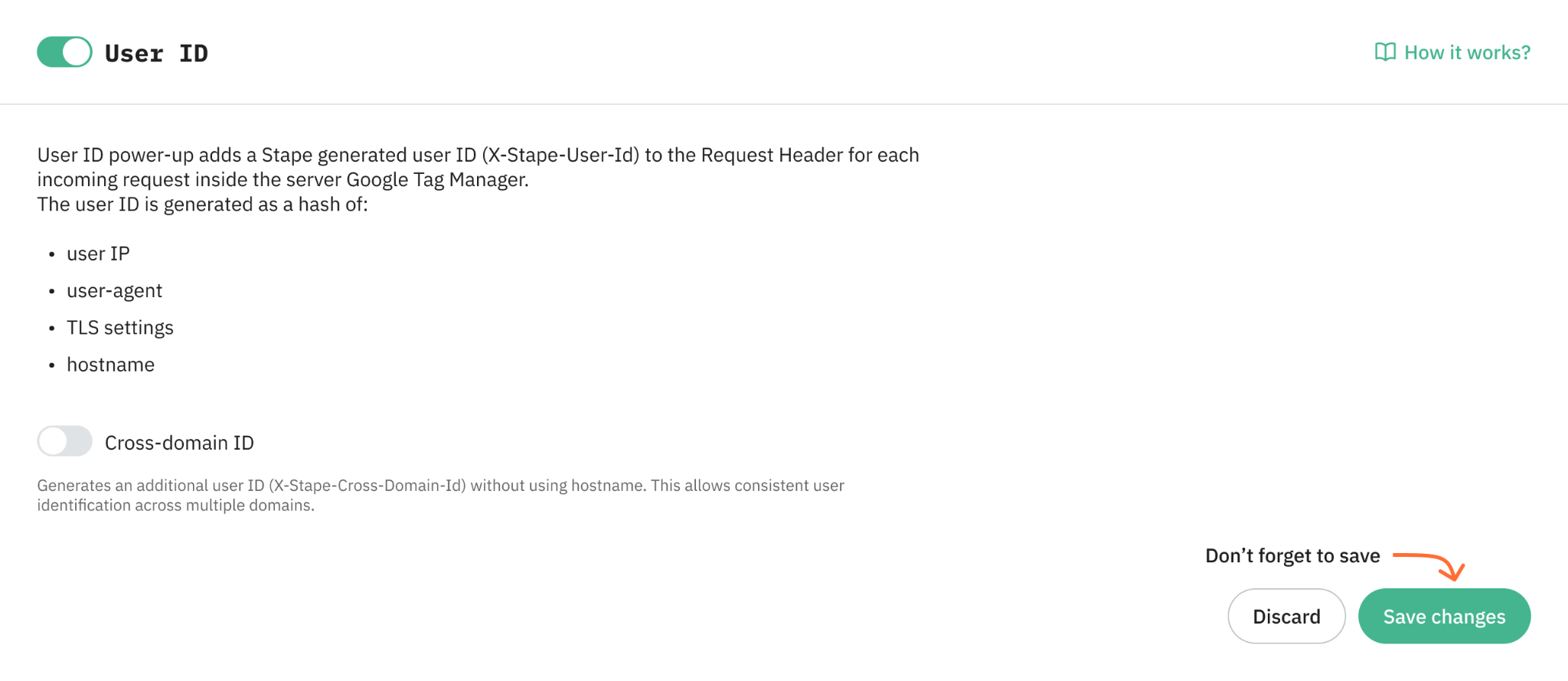
How User ID works
User ID creates a hashed identifier from signals in the incoming request, such as user IP, user-agent string, hostname, and TLS settings. Stape adds this value to each request processed by your sGTM container as the X-Stape-User-Id request header.
Since hostname is part of the hash, the same visitor gets a different X-Stape-User-Id on each domain. If your user journey spans several domains, you can enable the Cross-domain ID option. It adds an additional X-Stape-Cross-Domain-Id header, generated from the same signals except hostname, so the same visitor gets one ID across all domains that send requests to your sGTM container.
After you create a Request Header variable in sGTM for X-Stape-User-Id (and X-Stape-Cross-Domain-Id, if enabled), your tags and variables can use this ID where your tracking setup needs a user identifier.
Benefits of User ID
- Recognize returning visitors more consistently. User ID adds a hashed identifier to incoming requests, helping your tracking connect related events when browser cookies are limited.
- Send more connected data to your tracking tools. Add the User ID to supported tags and variables, so analytics and ad platforms can work with the same visitor identifier across related events.
- Keep Cookie Keeper working when other identifiers are unavailable. Configure Cookie Keeper based on Stape User ID and use it as the master cookie when you cannot set up a consistent master cookie.
- Connect visitor activity across your domains. Enable the Cross-domain ID option to recognize the same visitor on all your domains, for example, when they move from your main website to a checkout on a separate domain.
Improve user matching with server-side tracking
Use User ID to add a hashed identifier to incoming sGTM requests and connect related visitor activity more consistently when cookies are limited.
Useful links
Related to this solution
Blog
How to anonymize user data in Google Analytics 4
Anonymize GA4 data for GDPR compliance using Stape's Anonymizer or manual GTM redaction. Remove PII like IPs, client IDs, and referrers to protect user privacy.
Blog
How to easily add user agent and geo data to server Google Tag Manager
Discover how Stape's User Agent Info and GEO Headers enhance server-side tracking by providing valuable device and geographic data for your sGTM container.
Case studies
Breadcrumb tracking for cross-session and cross-device user identification | Leopose Digital
Find out Leonardo Pose’s Breadcrumb data tracking method, and what role Stape's power-ups play in shaping this methodology.