Jul 22, 2026
Avoid the harmful impact of ad blockers on your website tracking code
Written by
Ivanna Holubovska
Updated Jun 26, 2026 comments
More and more questions arise about how to make Google Analytics 4 (GA4) tracking reliable, especially with the growing influence of adblock detected bypass. Many users are seeking solutions on how to bypass adblock detection and maintain accurate tracking, leading to a surge in inquiries about how to get past adblock detection without compromising data integrity. Approaches like Google Analytics cookieless tracking are also gaining attention, as businesses look for ways to preserve data quality while adapting to stricter privacy standards.
That’s why we've developed a powerful feature for our Custom Loader power-up – Enhanced ad blocker protection, which:
- Activates encryption for GA4 requests.
- Enhances the resistance of your GA4 scripts against adblock blockers bypass.
- Protects the integrity of your tracking code and preserves valuable data.

How does “Enhanced ad blocker protection” work?
- 1.When the Google Analytics tracking code is triggered, it gathers data about the visitors to your website.
- 2.Each action or event (e.g., pageview, click, transaction) triggers a separate request to gather the information.
- 3.This data can be lost if the visitor uses an ad blocker, which identifies patterns in the request URL (e.g., "/g/collect") to flag data collection. Even if you use a server-side tracking for GA4, ad blockers can still block requests using the /g/collect pattern used by GA4 events. Our “Enhanced ad blocker protection” encrypts these requests, making them unrecognizable to ad blockers.
- 4.GA4 processes the requests by grouping individual events and associating them with the corresponding session.
How to activate “Enhanced ad blocker protection”?
| This feature is available for all users that are hosting server GTM container on Stape. If you don’t have a Stape account, please sign up and follow a detailed guide on how to set up server-side tracking in our blog. |
Custom Loader
Enhanced ad blocker protection is a setting inside the Custom Loader power-up, not a standalone feature. To turn it on, you'll first need to set up Custom Loader for your container — the toggle is simply one of the options you'll configure along the way.
Ad Blocker Info
While Custom Loader helps you bypass blockers, Ad Blocker Info power-up shows you how many of your visitors actually use them. It adds a header to every sGTM request and returns true if an ad blocker is on, and false if not.
This way, you see the real share of traffic that hides ads and decide if you need to change ad placements or budget.
Measure results of server-side tracking with Stape
With Requests Analytics you can observe how “Enhanced ad blocker protection” has influenced your Google Analytics 4 performance.
It helps to understand how many users you have with technologies that interfere with tracking (adblockers). But the number of users depends entirely on the audience that visits your site, in some cases it is 5% of the audience, in some 50%.
If you would like to activate Requests Analytics and see the value of using server side, simply go to your Stape sGTM container to turn on Analytics.
Use case
A client activated Requests Analytics in early November. Initially, they observed that only 8.55% of their website visitors were being tracked by Google Analytics 4, which corresponds to the percentage of visitors who had ad blockers preventing GA4 tracking.
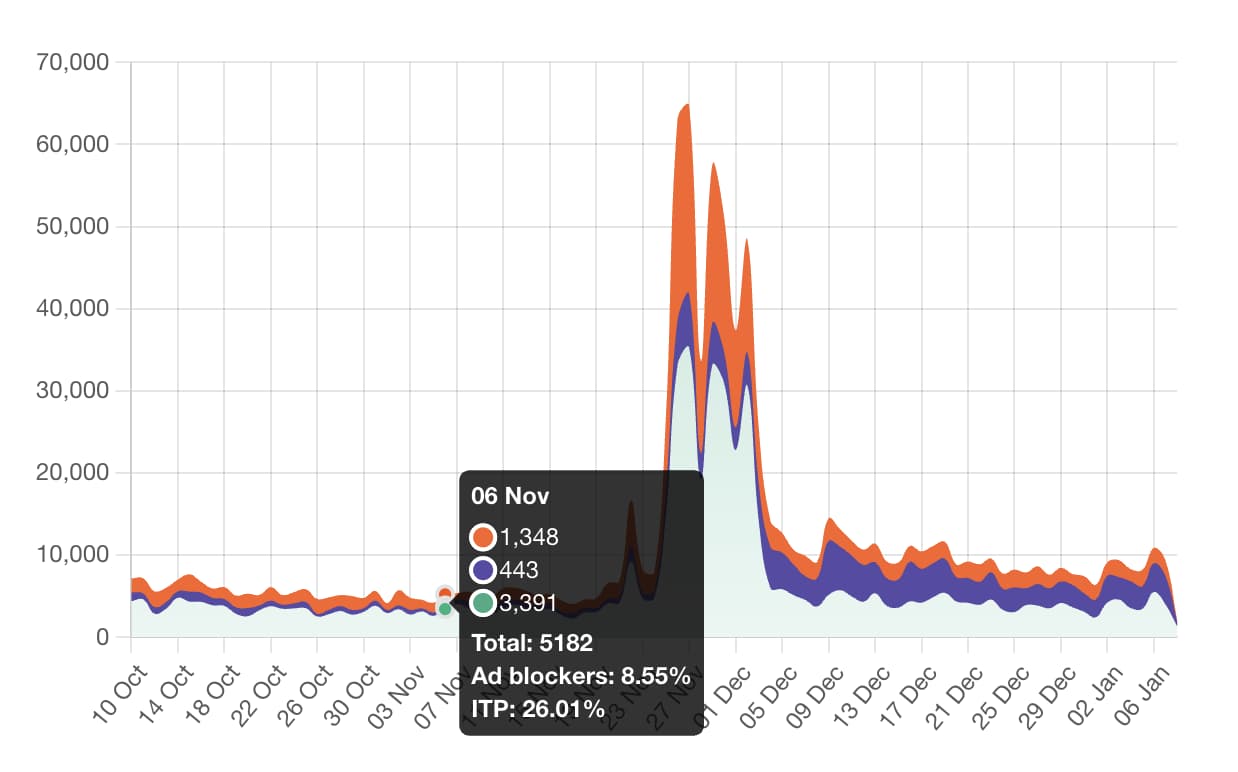
The client was losing valuable data from a significant portion of their website visitors, as users with ad blockers were not being tracked properly by GA4. This limited the accuracy of their analytics and the insights they could gain for optimizing their marketing strategies.
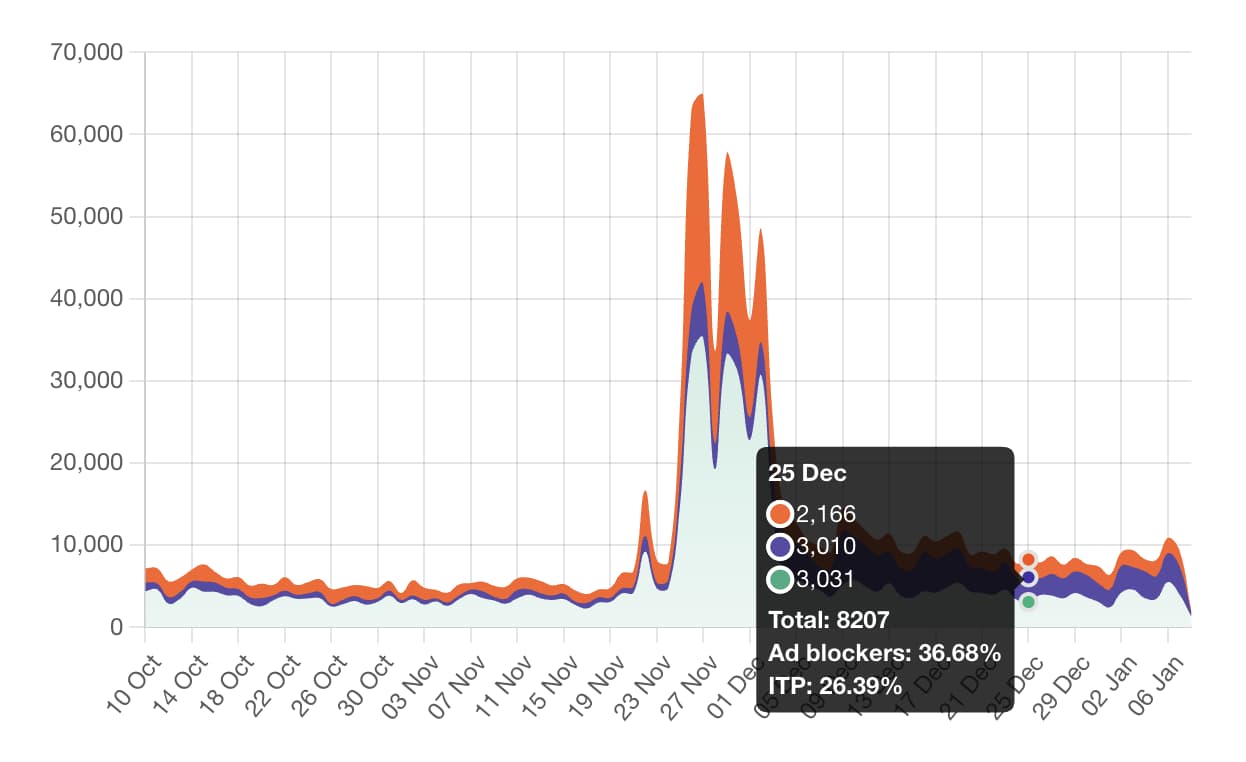
After activating "Enhanced ad blocker protection" toggle within Stape's Custom Loader in late November, the client observed a significant improvement in the tracking accuracy. The percentage of website visitors with ad blockers increased to 35% on average, and these users were successfully tracked by GA4 thanks to the bypass functionality.
Case study: 20% of data recovered from tracking prevention | Peak Metrics
- Challenge: losing a massive volume of critical user data due to ad blockers and browser limitations like Safari's Intelligent Tracking Prevention (ITP).
- Solution: server-side tracking implementation via Stape using a custom subdomain (e.g., sgtm.yoursite.com) and identifier backups to route data securely through a resilient, first-party server environment.
- Results: successful recovery over 20% of data blocked by ITP and 3.3% blocked by ad blockers, including a 30.6% recovery of lost purchase events during a 10-day test.
Learn more about how Stape can improve your tracking:
Want to start on the server side?
Try for freeRecommended for you
Solutions
Custom GTM and GA4 Loader
Oct 1, 2026
Solutions
Requests Analytics
Requests Analytics shows how server-side tracking restores requests blocked by ad blockers and browser restrictions.
Oct 14, 2026

Comments